 |
 |
 |
 |


|
|
|

|
Who'll Stop the Rain
|
 |
|
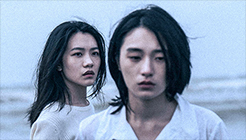
“Everyone is like a new canvas that can be painted in different colours”. So speaks art student Chi-wei (Lily Lee), who is about to enter a turbulent phase of her young life in which all matters of politics, sexuality and creativity are open to question. This is the debut feature of writer-director Su I-Hsuan, after Where the Sun Don’t Shine for TV in 2018. (Note the symmetry of titles! Also note that, despite the English format of the newer title, Creedence Clearwater Revival does not appear on the soundtrack.) She revisits the memory of a prolonged strike at a Taiwanese art school in 1994. Students back then protested the cause of “creative freedom” in the face of patriarchal authority figures insisting on conformism and conventionality. Worse still, the art history curriculum is entirely Westernised; Taiwanese art is accorded no value. This is a system seemingly impervious to the waves of social change that began earlier, such as the Wild Lily student movement of 1990. And also to artistic change, as Chi-wei discovers, innately, as she slashes defacing paint onto her previously staid work-in-progress. Who’ll Stop the Rain is, above all, a stirring love story. At first, we may think that the handsome activist Kuang (Roy Chang) draws Chi-wei’s attentions. But he turns out to have a pronounced regressive, misogynistic streak. So, her desire soon redirects itself toward Ching (Yeh Hsiao-fei), a withdrawn, depressive, but more authentically radical figure in the Student Association. The romance of Ching and Chi-wei reverberates, in its intensity, through all the moral and social issues raised by unfolding events. In global queer-cinema terms, it may all seem rather glossy (cinematographer Chen Ch-wen turns on every imaginable effect of luminosity), even tame. But remember that Taiwan did not legalise same-sex marriage until 2019. Speaking of tameness, though, one aspect of the film is especially remarkable and enjoyable (and shouldn’t be put down, as one reviewer at Asian Movie Pulse has done, to “poor editing”!). The slightest kiss between women takes a long time to happen: there’s the lean-in, the pause, the freeze, the will-they-or-won’t-they, the slight withdrawal, the slow return of sympathetic movement of two bodies toward each other, the building of the music … We haven’t seen such exquisitely prolonged sexual tension since 1930s melodramas! What’s that old phrase (from Talleyrand in the 19th century) that did the rounds of art cinemas in the 1960s? Only those who lived before the revolution know the sweetness of life … Or, as Chi-wei phrases it: “Only when you rebel can you feel alive”. © Adrian Martin 15 November 2023 |


