 |
 |
 |
 |


|
|
|

|
Marco Bellocchio On (and From) the Years of Impegno |
 |
|
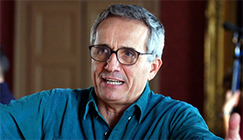
In Italian culture, impegno is a term referring to a strong political involvement or commitment – similar to the word engagé in French. From the mid 1960s through most of the 1970s, Marco Bellocchio (born 1939, and still intensely active today at 86) was identified – and identified himself – as a leftist political filmmaker. He was involved with collective groups, and collaborated on several militantly-oriented documentaries in this period – as well as a satirical agit-prop short, Discutiamo discutiamo (“Let’s Talk”, 1969), which is described in detail in Clodagh Brook’s useful book Marco Bellocchio: The Cinematic I in the Political Sphere (University of Toronto Press, 2010). The content of his documentaries from 1968 is evident from their titles alone: Long Live the First Red and Proletarian May, and Paola: The Calabrian People Raise Their Heads. It would be accurate to say, moreover, that while Bellocchio’s priorities shifted, interwove and mutated in subsequent decades – leaning, for example, more into the personal realm illuminated by various forms of psychoanalysis (but still sometimes involving collectives) – his films have never ceased working over the formative, charged and contradictory experiences that impacted him during the years of impegno. Evidence of this can be sought not only in the numerous works he has devoted to the Red Brigades and their 1978 kidnapping of Aldo Moro – culminating in the remarkable TV series Esterno notte (2022) – but also the tragic tale of his twin brother Camillo who suffered depression and committed suicide in 1968, as explored in the achingly personal documentary Marx Can Wait (2021). We must add to this project of incessant recall and self-questioning a phenomenon that is deeply ingrained within Italian public culture at large: the sense of responsibility that one must live up to the status of being a true citizen (whichever ideological side one is on), and hence responsive to events and developments in society as they occur. Pier Paolo Pasolini’s unrelenting activity as a mass media journalist, alongside his prolific filmmaking and poetry, is a testament to how Italian artists and intellectuals have attempted to fulfil this obligation – often causing widespread, lingering controversies in the process. As recently as 2006, Bellocchio even put himself forward as a candidate for the Italian Parliament, as part of the Rose in the Fist alliance of socialists and radicals (the same party that Enzo Tortora joins in Bellocchio’s TV series Portobello [2025]) – despite his oft-expressed disillusionment over the prospect of any effective leftist solidarity in Italy. The existentialist notion of bad faith – compromise, co-optation, selling out, hypocrisy, remaining silent in the face of an evident crisis, acts of betrayal stemming from deep self-repression – has been a constant (and constantly varied) theme in his cinema. It can be convincingly argued that all Bellocchio’s films are political, in one way or another, at one level or another. This is stronger than the familiar, often bland statement that “all films are political” because they somehow inevitably reflect, absorb, bolster or contest the social world that created them. Bellocchio’s work is actively and self-consciously political, pitched to become part of the general unruly discourse of ideas and issues at any given moment. Clodagh Brook underlines the specificity of Bellocchio’s context and his intervention. Bellocchio’s political filmmaking … is remarkably circumscribed in geographical, temporal, and thematic terms. It treats only one country – Italy … It treats only one time period – the late ‘60s and ‘70s. Moreover, it focuses on thematic material centred only on the Italian left and extreme left. A broader, more international vision is simply not entertained, except perhaps at times by extension. (1) Let’s return to Bellocchio in his early and mid 20s – back from filmmaking training at the Slade School in London in 1963 and 1964, and now plunged into the ferment of culture and thought stirred by his brother Piergiorgio (1931-2022, who appears in Marx Can Wait) as co-editor of the influential journal Quaderni Piacentini. Indeed, this publication organised a lengthy epistolary dialogue between Bellocchio and Pasolini to signal the significance of the former’s stunning debut feature, Fists in the Pocket (1965). (Eventually published in 1967, it was revealed three decades later that Bellocchio’s half of this exchange was in fact mainly composed by Quaderni Piacentini’s other chief editor, Grazia Cherchi [1937-1995].) During 1966, Bellocchio contributed two essays to Cahiers du cinéma magazine’s then-ongoing survey into the “Situation of the New Cinema” – New Cinema understood as a global, post-Nouvelle Vague phenomenon marrying artistic modernity (particularly Pasolini’s concept of a cinema of poetry) with burgeoning political crisis and radicalisation. From one piece to the next (appearing in consecutive months), and indeed within each of them, Bellocchio’s position-taking appears to waver (he may well be responding to an invisible set of discontinuous prompt-questions). In the first essay, “Revolution in the Cinema”, Bellocchio pessimistically compares Italian ‘young cinema’ with the shining example of the Brazilian Cinema Novo movement. He also – as every Italian filmmaker inevitably does – looks back on and evaluates the heroic years of Italian neo-realism. Revolution
in the Cinema (March 1966) Political cinema is a cinema that interprets the reality of class with absolute objectivity, with the aim of provoking it. It achieves this by casting off from this reality all aspects that do not refer to a social condition but are instead irredeemably private. It uses a style that makes it universally comprehensible and that, at the same time, saves the interpretation from mere didacticism. Neo-realism was a movement that expressed a revolution whose most crucial and vital phase was already over. Brazilian New Cinema is more important, to the extent that it can actually provoke a revolution. Such significance must, consequently, make it more responsible from film to film: by avoiding, for instance, the melodramatic, epic or petit-bourgeois tone that characterises certain neo-realist works. In a very fine film such as Black God, White Devil [Glauber Rocha, 1964], a baroque style of editing seems sometimes happy to leave the spectator in a state of wariness – thus compromising the movie’s great value. In short, it is necessary that the renovation of language and the critical interpretation of Brazilian reality coincide more frequently, because they cannot exist apart. They exist only to the extent that they co-exist. A reactionary or simply reformist, misguided interpretation blocks all stylistic achievement, in the same way that a poverty of style never allows a convincing – i.e., critical – political interpretation. On the production level, neo-realism is like other more recent movements in North America or France that have sought, in order to survive, to free themselves from pre-existing industrial structures, with the ultimate aim of destroying this commercial racket; while Cinema Novo seeks to skittle the bases of a Brazilian industry that does not yet exist. There is no “New Cinema” in Italy. I do not believe that conditions are favourable to provoking a unified movement that could reproduce the structure of Brazil’s Cinema Novo. Italian political reality – chronically social-democrat, allied with the temptations of industry – influences the majority of young people, who are preoccupied only with finding prestigious, well-placed mentors. The youth are obsessed with not being mistaken for amateurs, because they have already themselves confused professionalism with integration into capitalist industry, and the acquisition of a profession with possession of the means to acquire it. The attitude of the Young Italian Cinema toward its “great masters”, like Roberto Rossellini, Luchino Visconti, Michelangelo Antonioni and Federico Fellini? Sheer perplexity. Perhaps they believe it’s the right moment to take the elders’ place. That’s an inevitable fate for all of us. I wish to declare that, to interpret the Italy of today, we perhaps need younger people, more dynamic, more infused with dialectical spirit. I am not saying that academicism has overcome the “great masters”. Their films are quite honourable – but less good than they once were. Only Fellini has managed not to fall into merely wishing to “gather the faithful”. He always stays at the top tier of the avant-garde and looks, with each new film, for ways to produce a small revolution. But he succeeds only in being extravagant and unpredictable. The ideas he proposes are always the same. I’ll say it again: this outcome is a natural process of organic dissolution. A month later, Bellocchio expresses an even darker opinion on the possibilities of progressive cinema in Italy – a position in fact very close to the one Pasolini formulated in their exchange of letters. The
Sterility of Provocation (April 1966) It’s objectively true that a good advertising campaign is indispensable for a film’s successful launch into the world, but this passage cannot be indefinitely sustained if it doesn’t already possess some real way of pleasing its audience. In such cases, the film inexorably fails, becomes useless. For the public to really respond, it needs a transcendent experience. It must leave the cinema with the impression of having seen a good spectacle (an impression also, certainly, created around it by effective publicity). This spectacle must not only take account of the public’s problems, its aspirations and frustrations, and so on. It must also show these concerns in the most pleasing, most tranquilising way, forgiving or even accusing these sins, while leaving each spectator’s personal vanity untouched. Even provocation is generally met with indifference. Italians are not puritans, self-satisfied and proud of their condition. Quite the contrary, in their innermost being, they are unsatisfied provincials. It’s difficult to scandalise them, because, in fact, they begin from an attraction to the scandalous. They aspire to it. This explains a film such as La Dolce Vita [Fellini, 1960], which tries to surpass its Roman borders and maintain a discourse addressing everyone (as if it were possible to recognise universal constants in the facts and characters it offers) – but it cannot make the average Italian recognise themself on screen. Quite the contrary, this Italian surrenders to the charm, and la dolce vita remains for him, rather, a goal: the illusory realisation of all his impossible and contrary aspirations. Intriguingly, Bellocchio’s diagnosis of Italian provincialism here echoes a theme of the thesis he wrote while at Slade on acting styles in the films of Antonioni and Bresson. Citing an article from Bianco e nero magazine that targeted Antonioni’s “closed, proud, miserable” provincial attitude at the time of Il Grido (1957), Bellocchio welcomed the change inaugurated in that career by the event of L’avventura in 1960: he “goes outside his province, his moralising, his frustrations [and] becomes part of the world, integrates himself, makes intimately his own the experience of others”. (2) Bellocchio might well have been reflecting on his own life situation in the mirror of Antonioni’s. Near the end of 1967 and into the beginning of ‘68 – and now with two features touring the world, Fists in the Pocket followed by China is Near (1966) – Bellocchio tasted first-hand the revolutionary actions of a generation younger than himself, first in Turin and then in Rome. This brought about a decisive, politicising shift in his activities; he joined the Marxist-Leninist Union of Italian Communists. Bellocchio recalled his inaugural revolutionary experience three decades later. [In Rome] I infiltrated the arts faculty, which was occupied that very day. I remember the assemblies, with the journalists from middle-class newspapers who had to pay an entry fee, the exams under siege, and third-class marks for everyone, the nights in the faculty and the parents who came to look for their children, the telephone calls to Cuba from the main line of the occupied Secretary’s Office – “Hello? … We’d like to speak to Fidel Castro … Is he home?” – the dawns with hot croissants while we waited for the police … the charge of the police, preceded by three trumpet calls and certain kids, who had been anonymous up to a moment before, who, to their own surprise, discovered themselves to be great street fighters … great orators, without ever having spoken before … There you have it, in the chaotic and very vital collective movement, everyone discovered that they were another, and someone whom they would never have dreamed of becoming, a different person, someone who was much more original. (3) In the Name of the Father (1971) comes near the end of Bellocchio’s most intense period of political involvement and commitment. A film that refers to Jean Vigo’s anarchist classic Zero for Conduct (1933) as well as Lindsay Anderson’s near-contemporaneous If … (1968), it announced Bellocchio’s lifelong devotion to Buñuelian surrealism. His position had already started to change and evolve in 1970. A particular dramatic method, to which he would often return in his work, consolidated itself in this film: the opposition of characters as embodiments of conflicting ideologies, lifestyles, value-systems. Here is how he described the project in 1973 to a journalist from the French newspaper Le Monde. I was born in 1939. The years 1958 & 1959 represented a decisive turning point for the people of my generation – a crucial stage in our intellectual formation. The death of Pope Pius XII was, for us, the equivalent of the de-Stalinisation of the Soviet Union; a new Pope, John XXIII, stood up against the political edifice of his predecessor and, as it seemed, the government began to open up to the Left. I also chose this period because a film, for me, is above all a matter of images, sensations and objects: the reality of a 1970s college is foreign to me, and it seemed to me better to depict what I knew. At the outset, I considered establishing a dialectic between present and past times, by showing the story as a series of flashbacks – but I ended up taking out the contemporary scenes, because the procedure seemed too schematic to me. The film is an allegory: it shows Angelo (Yves Beneyton), the technocratic student, manipulating Franc (Aldo Sassi), the ideological student. These are not realistic characters. They represent the twin souls that inhabit every intellectual: the temptation of power, and ideological discourse – a discourse that is more cultural than actually efficacious. That contradiction is in me, too. In this precise case, I stage a very particular reality: ideology obeys a certain voluntaristic idealism, while it struggles against its own fragility; and Angelo, the technocrat, endeavours to put each thing, each person, in its proper place. He comments: “I kill. You write.” Franc, the idealist, sees how the illusion of power wins out on every front. He must become a whole, total man – but when he tries to kill, he can only take aim at the image of his mother, shooting into a mirror.
2. See Henry K. Miller (2018), “The Nonconformist: Marco Bellocchio and His Protest Cinema” in Sight and Sound. back 3. This passage comes from the material gathered by Paola Malanga & Goffredo Fofi for a 1998 Catalogo ragionato (Catalogue raisonné) devoted to Bellocchio. back
|
