|
 |
 |
 |


|
|
|

|
Cinema Invents Ways of Dancing |
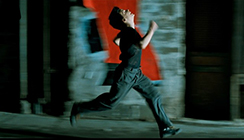 Mauvais sang |
I
begin with a scene from Leos
Carax’s Mauvais sang (Bad Blood, 1986), by now
very well known and widely celebrated – a fusion of wild,
uninhibited running (a form of escape, or release) and music. Before
the famous David Bowie song “Modern Love” begins, Alex (Denis
Lavant) explains to Anna (Juliette Binoche) that, simply by flipping
the dial of a radio, one can “listen and let one’s feelings flow
as they will”. (Lavant has enjoyed association with two
anthological scenes of this kind: this one from Mauvais
sang, and another from Claire Denis’ Beau
travail [1999].) [2026: Carax staged an inspired recreation of
the Mauvais sang scene
with the puppet figure from his film Annette (2021) for the finale of It’s Not
Me (2024).]
First, let me fill you in on the meaning of my title: “Cinema Invents Ways of Dancing”. It is, in fact, a misquotation, a mix-up in my head. Philippe Lançon once wrote in Libération newspaper, in the course of his coverage of Godard’s 2006 Pompidou Centre exhibition Voyage(s) in Utopia: “One sometimes recognises a cultivated person by the kinds of mistakes they make …” (2) So: I thought I was citing a sentence from Serge Daney. But when I looked it up for verification, I realised it wasn’t exactly as I remembered it. I had, in fact, first seen it used as a caption to a screenshot (in a text by someone else entirely, about a scene I address below) from Abel Ferrara’s King of New York (1990), where its sense seemed to be that “a [screen] story invents ways of dancing”. However, in the original context of Daney’s 1993 book The Exercise Has Been Beneficial, Sir (the title is a line from Fritz Lang’s Moonfleet [1955]) – a book of diaries, notes and reflections in the year of his dying from AIDS-related illness – it meant something quite different. Daney was, in fact, distinguishing between a story (histoire with a small h) and History (Histoire with capital H) – i.e., big history, world history, real history. And of this History, he states (somewhat cryptically) that it “invents ways of dancing”, because each of us is “dancing with chance, with what is unpredictable, with the amateurism of the world, its cloud-banks, faces, etc.”. He adds: “We are passive within History, even its victim, but only in the first instance: after that, we develop a talent for improvisation, like in jazz” (my emphasis). (3) I extrapolate three levels from that statement: 1. Stories (specific screen stories) can invent ways of dancing. 2. History creates – in fact necessitates – ways of dancing. 3. Cinema (this is how I misremembered the phrase, in my opportune and extremely cultivated way!) invents ways of dancing – because of certain properties, certain potentialities of the cinematic medium itself. I will be showing only one clip from a conventional musical, and no music videos at all. The rest are something different. So what do I mean by an ‘invented way of dancing’, or a (somehow) new form of dance? First,
I’m interested in the crossover between cinema and a certain
tradition of modern dance. An initial impression that I recorded at
the movies during the 1990s: the sudden, even disconcerting explosion
of dance-like movements and gestures that are apparent in the screen
performances of Lily Taylor, especially in films as boldly stylised
and non-naturalistic as Arizona
Dream (1993) and The
Addiction (1995). That’s like a sudden contradiction of realist space and dramaturgy. But there is, more broadly, a
tradition that, in a different manner, derives dance choreography
from everyday gestures, such as walking, running, lifting objects,
waving hello, smoking, sitting, standing, and so on. It is a
tradition that includes the names of Merce Cunningham & John Cage
(see Jackie
Raynal’s invaluable 1960s film documentation of their
collaboration), Yvonne
Rainer, Pina Bausch, and (in Australia) Meryl Tankard,
Laleen Jayamanne, and Lyndal Jones. We can even trace the tradition
back to Jean Cocteau’s films of the 1930s and 1950s. [2026: see the
extraordinary footage online of Tankard’s contemporary recreation
of Bausch’s 1978 Kontakthof with the surviving original performers, herself included, in the
video documentary Dancing Through
Time.]
I often remember what the Australian artist Frank Lovece (1956-2018) once explained to me: that when he set up his Super-8 camera and instructed his players to move in and through a locked-off, delimited frame for Te possino ammazza (1987), it was immediately an act or a process of choreographing dance – no matter the scene or the dramatic/comic/experimental context. The very birth of mise en scène! So, this is the first level of how cinema invents or creates dance: through the stylisation or choreography of everyday gestures. And the use of two parameters is worth noting at the outset: the frame edges; and the carry-over movement from one shot or one scene to the next, with all the continuity or discontinuity that this can imply. Let’s look at that second parameter more closely. Cinema creates dance precisely through its greatest powers as a medium that depends on the property of movement on all levels (people, objects, camera, even the very ‘grain’, pixels or particles of the image itself), and on montage. Cinema connects different, diverse movements. It links them into chains, flows of intensity. I do not mean by this only uniform or perfectly continuous movements (as in the ‘seamless illusion’ aimed for, in vain, by classical aesthetic style): we are speaking, rather, of intervals of movement at different speeds, in different directions. There is both break and flow in such a chain. (You’ll see that if you very carefully study and break down the Mauvais sang scene, which is often misremembered by rapt viewers as a single, unbroken take. And the way the scene ends – also rarely mentioned by its fans – is such a sudden deceleration!) Cinema is thereby constantly transforming movements one into another; and (in Gilles Deleuze’s lingo) it creates complex, major movements or ensembles of movement. I will register, in passing, my irritation with a constant refrain in film criticism and analysis: the invocation of an open, full frame for a complete body (seen head to toe), as in Fred Astaire’s classic routines, versus the chopped-up, fragmented, so-called ‘MTV style’ inherited (so we are told) from 1980s music video. [2026: It doesn’t polemicise on this point, but Timotheus Vermeulen’s invaluable 2026 book Plastic Time: Gesture on Screen tends to lean toward the ‘full body’ side of this argument, even when dealing with music video examples. There is little difference, for him, between the body as captured on screen and the body as we might witness it performing in theatre, or in daily life. I feel this avoids a central, crucial question about the figuration of the body in cinema – one addressed frontally, for example, by Alain Masson in his 2007 declaration that ‘the actor’s body does not exist on screen’, it is only ever constituted and reconstituted by the work of film.] (4) Let’s go back over, now, the stylisation of everyday gesture, using a scene from Lynch’s Twin Peaks: Fire Walk with Me (1992). Michel Chion (in his book on Lynch) has described beautifully the details I want you to notice. He evokes those Lynch scenes that “depict with freshness and violence some of life’s elementary sensations, [such as] the sense of having wings when the girl you love smiles at you”. (5)
The
act which consists of placing one foot in front of the other is not
self-evident: is there any better definition of a certain
self-questioning, self-conscious strain of modern dance?
We
must become attentive to the many ways in which everyday movement falls into – and out of
– configurations of dance. That’s exactly what is happening in
the Twin Peaks example. It
follows what Eric de Kuyper (a collaborator of Chantal Akerman)
called (in a magisterial text on the “Dancing in the Dark” scene
from The Band Wagon [1953]) the step-by-step principle: walking leads to dancing and back to walking … (7). This
is the one classic Hollywood musical example I will allow myself
here, because it is so rich. An
intriguing contemporary example of the step-by-step process can be
located in a little-known and even-less-celebrated film by Richard
LaGravanese, Living Out Loud (1998) starring (a characteristically brave) Holly Hunter. It’s a
musical mutation only for a single scene (that I can recall). An
indeterminate fantasy sequence takes place in a nightclub. At least,
I think it’s a fantasy
scene! The indeterminate nature of that fantasy is the result of a
specific choreography of movement: Hunter moves in a half-immersed,
narcotic, sleepy way into a
dance and back out. Her walking steps approach, form a bridge to, and
then retreat from the enchanted fantasy realm of dance. It’s a
mesmerising play on what might or might not be a real, collective
(and queer!) dance. A
personal intellectual-itinerary aside (bear with me for a few
moments): I came to the subject of dance and cinema through
(logically enough) the musical genre – but, more specifically, what
I have called the musical mutations (in varying degrees) of (generally) modernist cinema, which include a
bunch of the directors I’ll discuss forthwith. I began, along this
journey, with the (considerable) phenomenon of song (and the act of
singing), but was ineluctably drawn to the founding ambiguity of
cinema in its relating of music to movement. I became fascinated by
what Tom Gunning has referenced as the mysterious, indeed magical
realm of the supra-diegetic in films (his exceedingly mutated example is Fritz Lang’s amazing,
quasi-Brechtian musical You and Me [1938]) – more on this notion below. In
“Musical Mutations” (2000), (8) I questioned the received wisdom
that song-and-dance sequences are stand-alone, detachable spectacles
that always put the narrative into pause mode. They do not have to necessarily do so. And we
can turn these tables around to ask: what if we thought of plot
action itself in terms of dance action? Emir Kusturica’s Underground (1995), for instance, contains many complicated, action-packed
sequences (many things going on at once: a scenographic principle
imbibed from Federico
Fellini as well as from Jacques Tati) that are
constructed upon principles of dance choreography. Kusturica is a
maestro of what Lesley
Stern calls the histrionic in cinema, beyond the simple register of camp parody: action is an
exaggeration of itself, an enjoyable put-on, with heterogeneous
chains (of kids, animals, musicians …) put into dizzy circulation.
(9) One result of this in Kusturica is the questioning and explosion
of genre itself: Underground becomes a musical about wartime violence, which is not a standard
template … In every Kusturica film (as in my later example of Paul
Thomas Anderson), we experience a linkage of scenes, actions,
movements and moods into a complex, choreographic chain. When genre is loosened while connective chains of movement-action are multiplied, we enter the type of mutation that I think of as the almost-musical. Akerman’s delightful Tomorrow We Move (2004), among her least-appreciated films, is one such example. No doubt her inspiration for that project partly derived from Jacques Rivette’s experiment in Haut bas fragile (Up, Down, Fragile, 1995). Something is up in the mise en scène at the start of the seemingly ordinary meeting between Ninon (Nathalie Richard) and Roland (André Marcon) in Rivette’s film. [The scene described begins 5:25 into the YouTube compilation below.] In the airy studio where décors for film and theatre are constructed – a space pregnant with fiction, artifice and magic – the bodies of the characters slowly become possessed: they take very formal steps and almost strike poses, mention how “close and distant” they are from each other, and their dialogue takes on an incantatory rhythm, stuck on the repetition of odd words like perturbé (‘disturbed’). Then, with an amorous clinch and a perfectly timed cut closer-in, music begins – and singing and dancing, too. Almost an hour into this typical Rivette film about Parisian wanderings and conspiracies, and suddenly we are watching a musical? You can describe the punning song (“Ni oui Ninon” – ‘neither yes nor no’, more or less) as a whimsical piece of fluff, and you might find the dance a touch awkward or amateurish, but Rivette and his performers embrace it all: Haut bas fragile is about the dream of everyday life metamorphosing – via only the slightest nudges of stylisation – into the idealised realm of art, and specifically popular-musical art. Rivette’s
films, with their obsessive walkers and mannered talkers, have
frequently circled this moment of ignition into song and dance, but
here he goes all the way: love expresses itself in ironic, playful
postures and swooning falls – a low-key histrionics.
But the film always keeps that little,
charming margin of reality: the singing is live (and thus prone to
imperfection), and a shower of sparks to accompany the rapture of love ignited come from a welder’s
tool positioned discreetly in the background. Such examples led me to even larger impulses (as I like to conceive of them) in cinema: lyricism, and the still broader (and yet to be fully defined in all its extensions and levels) category of the cinema of poetry, which goes far beyond Pasolini’s initial, inspiring formulation of it. It was in this context that I came to love the musical – sometimes sung – passages in my favourite Akerman film, Nuit et jour (1991), that I have written, spoken and audiovisualised about (in collaboration with Cristina Álvarez López) elsewhere. (10) Aside over. Let’s focus directly on Akerman (1950-2015) as our next major example. She is often associated – in terms of aesthetic affinity – with the work of Pina Bausch, and in fact even made a splendid documentary about her in 1983. Akerman’s films, in turn, have inspired further works in dance and performance from others [2026: and continue to do so, beyond her death]. Toute une nuit (1982) is a special film in this regard. Charlotte Garson has described it as “a quasi-silent gestural ballet”. (11) It begins by establishing an ultra-formal kind of ‘network narrative’: across its first four shots, we see a city (Brussels), and then three different people walking separately, at different speeds. They seem to form one person (and listen for the song, Gino Lorenzi’s “L’amor perdonerà”, that travels through and links these diverse spaces in echoing fragments). Eventually, seven-and-a-half minutes in, we arrive at a wonderful bar scene (broken up into several pieces in the montage) in which two strangers literally fall into each other and begin dancing to the juke box blast of Véronique Sanson’s “Ma Révérence” … [2026: The Akerman Foundation polices the unlicensed use of clips from recent restorations of her work, so I encourage you to seek out the entirety of Toute une nuit in its best DVD edition.] Pertinent
here, both to Akerman’s film and Daney’s vision of History, is
Sandrine Marques’ description of Christophe Honoré’s Dans
Paris (2006): “Louis Garrel invents his own landscape,
on the basis of a series of decisions taken on the ground, in the
purest tradition of contemporary dance. Élan or inertia: the
equilibrium is precarious”. (12) Honoré’s film showcases an
immortal scene where a blocked, uptight, depressed guy (Romain Duris)
finally starts to loosen up as he listens (alone on his bed and in
his underwear) to Kim Wilde’s “Cambodia”. Marques also comments
that, in Honoré’s film, “gestural attitudes … organise a new
posture … a collective body” – an echo of Deleuze’s
ensembles. I shall return to this idea.
Toute une nuit introduces a further dimension to my general theme: that of social dance. I mean not just groups of more than two people dancing together (that is a common enough sight in cinema) but, rather, when specific attention is paid to often subtle codes of what is expected, what is allowed, and what becomes possible within socially circumscribed sites and situations of dance (such as a school dance, office party, dance training academy or dance contest). Potential mockery, humiliation and embarrassment in public are a key part of the repertoire of social dance spectacles. Basically, we are offered a concrete figuring-out of dance as a power relation or dynamic – the metaphor is writ larger and more obviously in Coppola’s The Cotton Club (1984, Encore recut 2017). Jean-Daniel
Pollet made a speciality of observing and recording social dance –
in all its whimsicalities and cruelties – in his work; and in my
2014 book Mise en scène and Film
Style, I analyse one such scene from Visconti’s White
Nights (1957) in detail. Of particular importance within
the realm of social dance is the particular joys (and infinite
varieties) of amateur dancing, clumsiness and ‘mistakes’ included
– the very thing that is most ruthlessly repressed in the slickest
of Hollywood musicals. (With exceptions, of course: Guys
and Dolls [1955] is a notable, delightful case.) Haut bas fragile devotes
several loving sequences to the fluid spectacle of Nathalie Richard
absorbed in her own, self-sufficient dance (these are included in the
compilation from that film provided above). [2026: On the motif of
‘dancing solo’, see my 2009 lecture “Dancing with Myself”
forthcoming on this website.] By the Bluest of Seas (1935) is a movie beloved of filmmakers. “Anything is possible at any moment of this film”, remarked an awestruck Otar Iosseliani. (13) Perhaps 50 years after seeing it, Godard remembered a particular scene [it begins at 3:15 in the compilation clip below] in a way that is wonky, but profoundly true to the spirit of its maker, the great Boris Barnet – and he paired the scene, on twin monitors in the Voyage(s) en utopie exhibition, with a comparative segment of song and dance in the Stanley Donen/Gene Kelly classic On the Town (1949).
Indeed, it doesn’t really matter that it's the woman (Yelena Kuzmina as Mariya) – presumed drowned at sea – who returns to her pals at the kolkhoz, as they hold a mournful wake for her; or that it’s her who asks, “Who’s dead?”, only to receive the delightful answer from one of her two handsome suitors: “You!” Because what does matter is the dancing that instantly breaks out and envelops the entire room: nutty, athletic, scarcely containable in the frame. It envelops Barnet’s cinematic language, too: the camera movements, the editing of image and sound, catch the spark. Ultimately, there is no need to damn the Americans in order to laud the Russian: Barnet, who seemed able to insert song and dance into any story (no matter how dramatic or tragic), simply rejoiced in the opportunity to transform and reinvent physical gesture, the figure in motion. In
the Barnetian instance, what we witness is a wild symphony of
movements joined up in a non-stop cinematic dance. And it’s not
merely metaphor to say this; the deepest structuring principle of his
cinema comes from the concerted interworking of the synchronisation
of bodies; ‘mass movements’ (of a crowd surging as one, for
example – also see Bertolucci’s choreography of a politicised
crowd at the end of 1900 [1976]); and the twinning of humans and creatures (the swooping birds
that are cut into this sequence). Barnet is, in this sense, the
predecessor to Kusturica. Let’s turn to the social drama of dance. The idea of the daily dance of power has two quite opposed meanings. First, dance as obedience (think of victim figures in Westerns having to dance to the gunshots fired at their feet … the ‘dance of the chicken’, the circus freak, or the trained animal). Second, dance as evasion or resistance, often through an outflanking or ‘mood switching’ (recall how the Twin Peaks scene modulates its mood via the transit into dance movement). Here
is a great scene from Ferrara’s King of New York. Frank White (Christopher Walken) is a
big-time gangster who has just been released from prison, and he is
about to be reunited with his gang. It’s important that the meeting
begins with an air of both mystery and tension, or intrigue in both senses of that word, on a pinpoint and a knife-edge – the
scene can go in any direction in a split second. (Ferrara is truly a
master at this kind of dynamic, as we see in a comical mode in the
sublime denouement of Go Go Tales [2007].) (15) The scene gives us a choreography built on tension and release. The steps, beats and marks of the scene plot out not only a choreography, but also a dramaturgy. In fact, we could go further, in general, with this concept of drama as choreography, even when dancing per se is absent. The films of Ferrara or Olivier Assayas – and, very richly, Billy Wilder – offer many examples of scenes that completely alter their mood and even the constitution of their spatiality in the course of an event (in King of New York, the scene where White interrupts a card game is exemplary in this regard). Walken channels all the ambiguity of the gang reunion scene through the indelible dance move that he ‘breaks out’ – that he invents in the moment. Walken’s screen career has often drawn on his background as a dancer: in Pennies from Heaven (1981), in Fatboy Slim’s immortal Weapon of Choice video (2001), and in another Ferrara film, New Rose Hotel (1998), in which he defines philosophical virtue as a literal matter of ‘hitting the mark’. In fact, Walken’s entire screen persona would afford a revealing case study about how plot action = dance action. A key aspect of social dance in cinema is the seizing of the loaded, implicit or pregnant aspects of everyday physical rituals – uncovering their hidden, latent, possible dynamics of power, opposition, generative (or disintegrative) tension, humiliation, and so forth. Think of the standard exercise in contemporary dance and drama classes, redolent of modernist minimalism in performance art: two people walk directly at each other, and who will bail first, who will give in to the superior will of the other? (I once had an unnerving experience on a plane flight where a severe, seemingly very traditional Muslim man – who did not once acknowledge my presence in the seat beside him in any way whatsoever – literally tried to walk through me to get off the plane at journey’s end, as if I was not even there. I had no other option than to give way to his Will!) If
you ever have the chance to see the unofficial work print of James L.
Brooks’ musical I’ll Do Anything (1994) – i.e., while it was still a musical, with songs
by Prince and Carole King and choreography by Twyla Tharp – spend
some good time with the number devoted to Albert Brooks ‘working a
room’ in the context of Los Angeles’ showbiz industry; it’s
priceless. A few image-and-sound glimpses of the original musical
conception appear in a trailer that escaped the studio’s
surveillance net. Next
up: John Waters’ A
Dirty Shame (2004). It contains an inspired scene
in which the Hokey Pokey, as used in a residence for the elderly (and
that probably happens in real-life residences all over the world) –
it’s mainly associated with the very old and the very young –
becomes the occasion for an explosion of unbridled libido. The
brilliant and gifted Tracey Ullman enjoys one of her finest screen
moments here. It’s a scene that travels from innocence to
catastrophe – as often happens (in another register) in Abel
Ferrara’s movies! When the lyrics arrive at (as in life) “you put
your whole self in …”, it’s impossible not to think: hey, the
Hokey Pokey really is quite a raunchy dance affair! You’ll never
see it, consider it – or participate in it – the same way ever
again. Paul
Thomas Anderson’s Punch-Drunk
Love (2002) boasts a strongly music-driven choreography of bodies. The film corresponds (deliriously!) to Rick
Altman’s evocation of a “transcendent, supra-diegetic music”
which Tom Gunning expanded: “the world itself responds … a
gradual enchantment of the diegetic world … as if infected by
rhythm or melody, given over to pure expressivity”. (16) Here in
this scatty supermarket sequence, we may well find sympathetic
confirmation – thanks to Adam Sandler’s prodigious performance –
of Godard’s intuition of the ‘American neurosis’ as expressed
in movement! The film explores intensive work on the articulation and fusion of gesture, rhythm and sound – and especially on speed, and the concept of variable speed or (as it is known in the digital effects industry) speed ramping. I have written elsewhere about the pre-digital origins of speed ramping in the bold in-scene editing transitions pioneered by Orson Welles in Touch of Evil (1958) and Godard in Alphaville (1965). Once again, as in Barnet and many other places, it is a matter of our consciousness of the dynamism of intervals and how they are arranged in polyphonic sequence. (17) I end with a complex work by Godard – who is the red thread in this presentation! – On the Origin of the 21st Century (2000), which I rate among his very best. It was a digital collage-montage commissioned to open the Cannes Film Festival of that year; naturally, JLG responded by throwing into the mix hardcore pornography and Holocaust-related footage … In some respects, the work is a spin-off from or postscript to the awesome Histoire(s) du cinéma (1988-1998) series. As with that work, don’t get hung up – literally don’t stop, don’t arrest your attention – on identifying quotes, references and allusions as they fly past you. You need to get in the flow, join the rhythm of this Origin to truly understand it. For it creates a vast, elaborate dance movement, a kind of arc or vector via the montage of pieces or intervals: and it begins and ends with actual dance, concentrating on images of feet. This is, simultaneously, a socio-historical movement … and a matter of life and death. A crucial generating motif of the work is the notion of the spirit which animates. On the Origin records the flowering and crushing of a movement, over and over: constantly returning to the image of the corpse, the object that ‘spirit’ has left behind … and motifs of exhaustion, crowding, rape, extermination … Godard leads us to reflect: there is precious, poetic liberation in dance; and there is, simultaneously, illusion, fake dreams, historic deception. And in this very gesture of combination and reflection, cinema truly invents a new way of dancing.
NOTES
(2026) 2. Philippe Lançon, “‘Ce qu’ils aiment à Pompidou, c’est les morts’”, Libération, 12 July 2006 (all subsequent translations from French, unless otherwise noted, are mine). back 3. Serge Daney, L’Exercice a été profitable, Monsieur (Paris: P.O.L, 1993), p. 131. back 4. Alain Masson, “D’où vient le geste?”, in Vincent Amiel, Jacqueline Nacache, Geneviève Sellier & Christian Viviani (eds), L'acteur de cinéma: approches plurielles (Presses universitaires de Rennes, 2007). back 5. Michel Chion, David Lynch (BFI, 1995), pp. 152-153. back 6. Ibid. back 7. Eric de Kuyper, “Step by Step: Reflexions on the ‘Dancing in the Dark’ Sequence from Vincente Minnelli’s The Band Wagon”, Wide Angle, Vol. 5 No. 3 (1983), pp. 44-49. back 8. Adrian Martin (2000), “Musical Mutations: Before, Beyond and Against Hollywood”, available as Tier 2 bonus for subscribers at my Patreon, https://www.patreon.com/c/adrianmartin. back 9. See, for example, Lesley Stern, “Acting Out of Character: The King of Comedy as a Histrionic Text”, in Stern & George Kouvaros (eds), Falling for You: Essays on Cinema and Performance (University of Sydney Power Institute, 1999), pp. 277-305. back 10. See, for example, “Pequeñas jugadas (#2)” / “Small Moves (#2)”, Transit, 5 November 2015. back 11. Charlotte Garson, “Les deux galeries”, 2 Films de Chantal Akerman (Cahiers du cinéma DVD collection, 2006), booklet, p. 2. back 12. Sandrine Marques, “Days of Being Wilde”, Contrechamp. Voyages en cinéphilie, 29 October 2006 (blog no longer online). back 13. Otar Ioselliani, “About Boris Barnet”, Projections 4 1/2 (Faber and Faber, 1995), p. 90. back 14. Godard quoted in Lançon, “‘Ce qu’ils aiment à Pompidou’”. back 15. See the audiovisual essay by Cristina Álvarez López & Adrian Martin, “169 Seconds: Waiting for the Miracle”, 16:9, 31 March 2023. back 16. Rick Altman, The American Film Musical (Indianapolis: Indiana University Press, 1987), p. 70; Tom Gunning, The Films of Fritz Lang: Allegories of Vision and Modernity (London: British Film Institute, 2000), p. 265. back 17. See “At the Edge of the Cut: An Encounter with the Hong Kong Style in Contemporary Action Cinema (2003)”, in Place of the Spectator: Essays on Film Theory (2003-2013), available as Tier 6 bonus for subscribers at my Patreon (see note 8). back
© Adrian Martin May 2004 / November 2006 / April 2012 (+ annotations October 2026) |