 |
 |
 |
 |


|
|
|

|
Ride a Black Swan: |
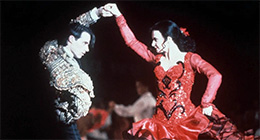 Strictly Ballroom Strictly Ballroom |
|
Introduction (2026). Since the beginning of my writing career, I have produced a large mountain of texts and talks on the topic of Australian cinema. I have kept most of the more substantial pieces from that pile off this website so far, because I continue to entertain the dream that, one day, somebody will actually want to publish the book that I hope to substantially re-weave from all this material, titled Australian Cinema at 4am: A Critique. All my attempts (and there have been many) at getting any Australian funding for this project over the past 20 years have duly failed. I wonder why? So here’s a glimpse at something from that mass of material: one of the five essays I wrote at the turn of the 21st century (in then-dying days of Cinema Papers magazine) designed to offer a comparative view of trends in then-current Australian feature releases in relation to a wider field of World Cinema (a comparison that very few commentators on this national cinema ever dare do!). John (“Stayin’ Alive”) Travolta turns his stride down a Brooklyn pavement into a dance at the start of Saturday Night Fever (1977). In David Lynch’s Twin Peaks: Fire Walk With Me (1992), a besotted teen stumbles backward through a schoolyard after his girlfriend has smiled at him – and, for a few magic moments, the sympathetic motion of all the other kids walking through the frame, plus the sudden, subtle, walking-bass beat in Angelo Badalamenti’s floating score, transform the action into a fragment of a Stanley Donen musical like The Pajama Game (1957) or Seven Brides for Seven Brothers (1954). In Leos Carax’s Mauvais sang (Bad Blood, 1986), the punk-acrobat Denis Lavant begins to limp down the street, accompanied by the sound of David Bowie’s “Modern Love” on a nearby radio – but then he walks, and then he runs, faster and faster, the camera framing his entire body in a near-unbroken, hurtling movement, as the song detaches itself, in aural terms, from humble reality and fills the entire sound-space of the film. Even in the days of silent cinema, this feeling of ever-potential dance existed: Éric Rohmer celebrated the way in which the German cinema master F. W. Murnau (Nosferatu, 1922) could turn the slightest passage of a character through an architecturally defined space – a vampire cruising under an archway, a man searching for his beloved in high, wild, billowing reeds – into a lyrically expressive ballet. Cinema is always close to dance, but the historical relationship of the two has been, and remains, sadly fractured. Every major form of dance has found its own, discrete ghetto in the span of audiovisual media, robbing us of the pleasure of other, unforeseen combinations. Popular dance forms, from tap to the Macarena, are the province of the film musical – which has long experimented with the integration of plot, characters and spectacle. High art dance forms such as ballet once formed the basis for concert films, and now hide out in slots on (so-called) quality television channels – too often shot in an unimaginative, proscenium arch, documentary mode, as if Michael Powell’s sublime The Red Shoes (1948), with its central ballet rated by veteran critic Raymond Durgnat as “the peak of cinema”, had never existed. Finally, modern and avant-garde dance forms, often partnered with the formal risks of experimental cinema (as in Raúl Ruiz’s dazzling Mammame [1986]), take refuge in specialist, fringe art events like Australia’s Reeldance festival [2000-2012]. Yet dance is making a concerted comeback right across the cinematic board at the start of the 21st century. Lars von Trier’s much-debated Dancer in the Dark (2000) is a hybrid of European art film and Hollywood musical. Claire Denis’ Beau travail (1999), a hit on the festival circuit, ends with a flamboyant dance sequence – again featuring the amazing body of Lavant – and subtly infuses stylised, choreographed, group movement into seemingly normal scenes of daily life in the French Foreign Legion. In the commercial realm, there appeared a sudden crowd of movies about low and high modes of dancing: Billy Elliot (2000) from UK, Center Stage (2000) from USA, plus the unusually daring Dirty Dancing sequel, Havana Nights [eventually released in 2004]. And two new Australian films, Dein Perry’s Bootmen (2000) and Lynda Heys’ Kick (1999). (Not forgetting a tremendous dance spectacle, for one scene, in Clara Law’s The Goddess of 1967 [2000].) [2026 postscript: neither Perry nor Heys have since directed further features.] In Hollywood’s studio era, stars like Fred Astaire and Gene Kelly developed their dance craft in and through film; their choreographic and directorial ideas helped shape the musical genre itself, while the possibilities of the cinematic medium influenced how they chose to dance. Nowadays, the situation is very different. Dance needs to be imported into film from outside – a popular fad, a prominent stage career, or an already established troupe. In a relatively small film industry like Australia, this kind of cultural importation of a neighbouring medium and its personnel can be canny and revitalising. Such was the drive behind Strictly Ballroom (1992). The film mingled the suburban ballroom dancing tradition with the rising star of Paul Mercurio and the playful artifice which director Baz Luhrmann had already developed in stage productions. Bootmen is transparently an attempt to take the elements of Perry’s successful Tap Dogs stage show – with its mostly male, very hetero, blue collar energy – and somehow coin a character-based narrative from it. Musicals that not only feature dance but actively explore it as a subject (by centring on auditions, training, benefit concerts, comeback performances, and the like) tend to select between a small number of dramatic or comic premises. The stories are often about the discovery of the dancing vocation – the case for the young boy (played by Jamie Bell) in Billy Elliot – or the re-finding of that lost vocation, as much for Sean (Adam Garcia) in Bootmen and Matt (Russell Page) in Kick, as for Astaire in Vincente Minnelli’s classic The Band Wagon (1953). Once the initial will to dance has been acknowledged by the hero, other, larger obstacles start to complicate the dream: class conflicts (the working class men in Bootmen and Billy Elliot regard dancing as a bourgeois affectation); changing cultural styles (virtually all modern dance films make the obligatory, respectful, awestruck nod to Astaire and Ginger Rogers in Top Hat [1935], but Sean in Bootmen realises the need to go beyond that model and be somehow modern); technological challenges (Sean, like Gregory Hines in Nick Castle’s wonderful Tap [1989], makes his breakthrough by finding a way to electronically amplify tap shoes). Not to mention that that ever-present, cultural split between the high and low arts of dance – which few films manage to mend satisfactorily, although most fitfully try. Then there are the problems of dance in relation to the building (or unbuilding) of the dancer’s personal identity. “Why can’t dancing be just fun?”, laments Jody (Amanda Schull) in Center Stage – and her teacher affirms that it is indeed fun, while gradually inculcating in her the way to balance spontaneity with hard work, inspiration with discipline. The dance movie is a close cousin, in this regard, to the sports movie – as cleverly avowed in the opening slow-motion shot of Kick, where a balletically twisting hand against a clear sky finally catches a football – because it involves a quite similar set of issues: the generational clash of young talent and mature coach; the testing of the human body as instrument and the ever-present threat of its physical injury; the limited time span in which the dance or sports star can truly shine in their chosen profession; and, most profoundly, finding a workable relation between those moments of fantastic intensity in the spotlight (on the stage or the field) and the entire remainder of a lifetime. Dance thus becomes a dramatic crucible in which the hero works through his or her flaws and limitations. Where, for little Billy Elliot, dance is a way to release the inner fire of frustrated rage, to literally smash through the walls of social confinement, Aussie dancers tend to have a somewhat more matter-of-fact, less romantic approach to personal overcoming. In Bootmen, the hero and his older, now crippled, mentor (played by William Zappa) argue mainly over whether or not a dancer should ever improvise; this is a homely, scaled-down version of Strictly Ballroom’s guiding theme, encapsulated in its repeated motto: “A life lived in fear is a life half lived”. Dance in these Australian movies is about individual courage, not social revolution – as it was, for instance, in some floridly modernist and fiercely political dance spectaculars from Latin America, China and Hungary during the 1960s and ‘70s. Above all, dance movies like to explore issues of sexual identity, and the influence of family. Bootmen, Kick and Billy Elliot all deal with the taint of gayness that attaches itself to a man who chooses to dance for a living (Perry’s film seems even uptight or defensive on this point). All these heroes struggle with the problem of having an overly stern father and a deceased mother – although (as in Strictly Ballroom and Billy Elliot) grandmothers who still possess the soul of rhythm come in handy as nurturing, maternal figures and plot resolvers. Even more important than the plot elements in such stories is the style in which they are rendered. Hollywood’s classic musicals of the 1940s and ‘50s devised a fine art from the many ways and means of getting into and out of a song and dance number. Walking leads to dancing which resolves itself ultimately in a graceful exit from the scene by tramcar or skateboard; humble diegetic music (as played or heard within the plot itself) is quickly taken by over an other-worldly, extra-diegetic orchestra, and finally returned to the bare bones of its original setting. However it happens, the crucial thing is that we feel and experience the birth of a rhythm, the swelling of a song and the explosion of a dance in synchrony as a primal, animating force: it includes everybody and everything, colour and camera movement as well as characters and plot, and it remakes the whole world as it catches alight. Many contemporary dance films, even those with the best intentions and citations, have lost the secret of animating rhythm (for that, we need to open our eyes to the still flourishing traditions of Hindi and Egyptian musicals). Too often today, musical numbers simply start and end, rather than building up and dying away. Those movies that lead up to a big showbiz finale often seem suddenly scared of boring us, and so whisk the song and dance action away after a cascade of edited highlights – which happens in both Billy Elliot and Bootmen. Most damaging of all is the adoption of a widespread, MTV-derived editing and post-production technique. No longer are the dancers’ gestures allowed to work in a synchronous, dynamic, unified way with the music, the moving camera and a precise, pre-visualised sequence of edit points. Rather, the dance is reduced to a random bunch of pictorial flourishes or swirls (slowed down, speeded up, shot from half a dozen angles and then frantically intercut), and the editing takes its cue from the metronomic beat of the music – which, for all its technologised splendour, seems awfully removed from the real space in which the dancers move and interact. Strictly Ballroom, Bootmen, Kick and Billy Elliot all fall prey to this terrible stylistic temptation. It’s certainly fun to hear rousing pop tracks like John-Paul Young’s “Love is in the Air” (Strictly Ballroom) or T-Rex’s “Ride a White Swan” (Billy Elliot) yoked to a story of dance. But where is that truly exciting, intricate fusion of sound and image? Center Stage, set in a New York ballet school, is my favourite of this cycle of dance films. Director Nicholas Hytner stages a splendid confusion of free dance, rigorous training and everyday activities – in the busy plot line, and in the multi-planes of many shots. Carol Heikkinen’s script absorbs elements of melodrama, backstage musical and comedy of manners, creating a smooth patchwork that is all at once (and without too much camp) reminiscent of 42nd Street (1933), Fame (1980), A Chorus Line (1985) and The Turning Point (1977). [Sad 2026 postscript: after contributing to three good music/dance-related films during the ‘90s, Heikkinen has no further screen credits beyond 2000.] Like The Red Shoes, Center Stage evokes the delightful imbrication of art and life (power intrigues mirroring classic operatic situations, lovers who move together both on- and off-stage), while also addressing the fateful problem of how to ultimately untangle them. The film takes on two dominant dance styles – a strict form of classical ballet, with its grand tradition, and a looser, free version of it inspired by salsa dancers in nightclubs – and maps this distinction onto two powerful and treacherous teachers: Reeves (Peter Gallagher, never better) and Cooper (the charismatic Ethan Stiefel). When it comes time for the final show, it’s Cooper’s wild and sexy soapie-in-dance that really sparks Hytner’s cinematic imagination: like in a Busby Berkley number, the stage limits of time and space are magically dissolved and transcended. What is most wonderful about Center Stage is its ceaseless flow, its movement, its rhythm – its sense of all things as infused with dance (like the wonderful detail of a dancer butting out a cigarette with a classically arched foot). This is what I miss in our MTV-influenced era, when song’n’dance routines burst forth as isolated numbers, rigorously separated as spectacle from the rest of a movie’s world. In an odd way, this disconnection chimes in with one of the chief intuitions of film theory devoted to the musical genre: that the intense, ecstatic, emotional release, and – even more strongly – the Utopia, perfect world or heaven on earth embodied in singing and/or dancing is merely fleeting, ephemeral, illusory, impossible. At its extreme, this thought gives rise to the Dennis Potter (Pennies From Heaven, 1981) lesson: the musical ideal is just a dream – and a bad, foolish dream at that. At the other extreme, there are radical musicals in the Jacques Demy (The Umbrellas of Cherbourg, 1964) tradition, in which the singing and dancing leak out everywhere, permeating every word, decor, gesture, every passage of a body through space: Chantal Akerman’s Golden Eighties (1986), set in a shopping mall, or Jacques Rivette’s sublime Up, Down, Fragile (1995), whose complicated, Center Stage-like intrigue is set in motion by a team of couriers zipping around a barren Paris-in-August on mopeds ... At least one Australian musical conjures this sort of reverie: Gillian Armstrong’s Star Struck (1982 – not Starstruck as it is regularly misnamed), on the cusp between classic Hollywood and MTV modes, conjures for scholar Stuart Cunningham an extended Utopia where “life aspires to the condition of music” in everyday scenes which are “as exhilarating as any formal production number”. The popular consumption of music, movies or theatrical spectacles is often portrayed in grey terms, as an utterly passive pastime. But viewing and listening are never passive: the body is always engaged by rhythms and energies, always caught up (even inadvertently!) in an infectious wave of transmitted or communicated feeling. That’s what these riskier films about the confusion of art and life are all about: grabbing this energy – which may simply manifest itself at first in a tapping of toes, the humming of a tune, the excited movement of eyes or the quickening of a heartbeat – and taking it along with you to somewhere else, investing it in the actions and movements of daily life, and thereby transforming them. Bootmen, at least, gives us one terrific set-piece on this theme: the dancers practising their moves and banging out their rhythms on the industrial, factory machinery they operate every day. The philosopher Gilles Deleuze, on an especially happy day, once proposed: “The cinema is always as perfect as it can be”. He was almost right. There is only one major problem with cinema as a social institution: audiences are not encouraged to dance while they watch films. If they did, we would all understand movies much better.
© Adrian Martin August 2000 |
