 |
 |
 |
 |


|
|
|

|
The Angry Hills
|
 |
|
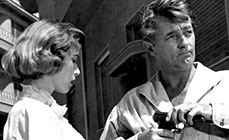
In Robert Aldrich's The Angry Hills – scripted, like Kiss Me Deadly (1955), by A. I. Bezzerides – there is a rather odd and remarkable auto-portrait
offered by the suave, murderous political villain of the piece, Col. Elrick
Oberg (Marius Goring), a true movie-Nazi by office and by ideology. These are
his first words, spoken as he steps briskly and dramatically out of a shadow: “I
suffer from palpitations of the heart”, he booms abruptly to a somewhat puzzled
and nervous Conrad (Stanley Baker). “I have strange headaches. My pulse is
irregular. I sometimes wonder whether I have a pulse at all”.
The Angry Hills is a decidedly minor
Aldrich film, disliked by both its star (Robert Mitchum as Mike) and its maker,
because of studio interference. But there are details in it that are haunting –
and all of them bear, like that little self-portrait soliloquy, on matters of
the human form and body.
In fact, I am struck by the way people’s cinephilic
souvenirs of Aldrich tend to congregate around memories of strange and
grotesque body-presentations: in Attack! (1956),
the shot of a soldier (Eddie Albert) frozen in a death-scream; the gruesomely
white, little-girl, pancake make-up on Bette Davis in What Ever Happened to Baby Jane (1962); or the stand-off between
men about to fight as they ride atop a train – once again, seemingly caught
eternally in this pose – in Emperor of
the North (1973). Driven sadists and screeching masochists at every turn –
none of them lovable, but all compelling in some weird way.
But back to The
Angry Hills, and particularly its style. In one scene a character, talking
secretively on the phone to Mike, is about to be killed – I should say erased, since Aldrich uses a characteristically
economical way of signifying this: he shows the character suddenly blotted out,
completely eclipsed by the deeply dark shadow of the person moving to stand
over him. When next we see this eclipsed guy, he is a corpse. This
death-by-dark-shadow business is a familiar noir trick. But here it borders on the stylisation of an abstract or experimental
movie, especially given the brevity of this visual event (the eclipse happens
in just a few frames) and the rapidity of the montage that contains it.
Another striking quality of this little fragment is
the extent to which Aldrich pushes contrasts – always the rapid contrast
between dazzling white and sheer black, both across edited shots and within
individual compositions. People in brilliantly white suits are forever stepping
in and out of sinister dark patches, sliced or bisected by this or that
devouring line or form. It reminds me of Joseph H. Lewis’ immortal The Big Combo (1955), or Anthony Mann’s
similarly extreme work in his noir films shot by John Alton, such as Desperate (1949). Like
Mann, Aldrich gives a strange, new life to the oldest of noir tics in a scene of The
Angry Hills: the overhead, swinging light bulb that makes bodies too-bright
and then too-dark, exacerbated once again by a rapid editing pattern.
The Angry Hills, a war film set (unusually
for a mainstream Hollywood project) amidst the Greek Resistance in 1941, has
never, to my knowledge, been listed as a film
noir, or even related sideways to that genre. But this is surely an
interesting thing about Aldrich: that many of his movies, which cover just
about all of the male action genres (even his “women's weepie”, Autumn Leaves [1956], is pretty
violent), tend to exploit a particularly paroxysmic form of noir stylistics.
In another passage of The Angry Hills, we see a different but related kind of spectacle
that inverts the scale of values regarding bodily, physical presence. Mike is
out in the streets of Athens, walking towards an arranged, secret rendezvous.
But suddenly he stops. It is almost a David Lynch evocation of the uncanny, or
what the old Catholic hymn "Soul of my Saviour" refers to as one of
“death's dread moments”: in front of him, and all around him, is a silent, depopulated
absence, but Mike knows, deep in his bones, that his murderers await him at
this criss-cross.
This silence, this emptiness, is paradoxically
invested with a thick, heavy presence. It is a variation on one of Aldrich's
most memorable and exhilarating set-pieces: the wide-open scene in Vera Cruz (1954) where, on cue, the vast
empty frame, revealed by the camera panorama-style, is filled with hitherto
hidden gunmen lined up all over the ramparts of a town – and we, like Burt
Lancaster as Joe Erin, just gasp at the awesome showmanship of it all.
The gifted music and cinema critic Dave Sanjek
[1952-2011] has spoken of the “purposeful avalanche of deformation” characterising, underlying and
animating the cinema of Aldrich. This idea of deformation can be taken as
literally and physically, as corporeally as possible. The more we look at Aldrich today – gazing back through the prism
of Sam Peckinpah, Quentin Tarantino, Kathryn Bigelow, Abel Ferrara and others –
the more we see how odd, how deformed, how unreassuring his stories and
characters, his images and sounds, were.
It’s a realm
of the grotesque that opens onto an
entire socio-political panorama, as filtered through the very unromantic
sensibility of this great and still somewhat underrated director.
© Adrian Martin January 2000 |


