 |
 |
 |
 |


|
|
|

|
Barres
|
 |
|
Luc Moullet’s gag-comedies, with their stunning
economy of means, owe something to Jacques Tati – but they have a harsher, more
political undertone.
All the neurotic eccentricities of the people in his
films (some of the most memorable incarnated by Moullet himself), all the
minute, daily, compulsive obsessions with counting, collecting, ordering, or
figuring out a routine, arise in response to the same, monumental object: a
near-fascistic Society of Control that places prison-like constraints around
every aspect of work and leisure in Western countries.
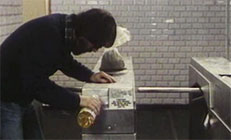
Barres, which is among Moullet’s best (and easily accessible online), is literally about society’s bars – those that appear at
entranceways in the French métro system to regulate and police customer
traffic. Moullet’s way is thus clear: he will list (in charmingly handwritten
titles), and demonstrate in rapid comic vignettes, the dozens of ways in which
wily citizens manage to sneak through this ever-renewed, ever-more complex
system of state-enforced discipline and punishment – without paying.
Everything proves useful in this solemn mission: chewing gum, string, auto spare parts, leaping and kicking skills. Incredibly – as Moullet spells out in his 2021 autobiography Memoirs of a Slippery Soap – it's all shot on especially constructed sets in a studio (something I have never realised across numerous viewings), one of the few times beyond his debut feature, Brigitte et Brigitte (1966), that he did not use real locations. This fact, however, did not stop France's transport authorities from complaining (after the initial TV broadcast) that he had shot his film illegally inside the metro, without a permit!
There is no plot as such in Barres, only a
parade of subversive, anarchic gestures, performed alike by young and old,
hippies and professionals … and occasionally interrupted by the corporate
billboards devised to discourage people from such “stupidities” (the same Franju-like
posters portraying humans as animals can be glimpsed in Leos Carax’s feature
debut of the same year, Boy Meets Girl).
Against this official State view, Moullet posits a
counter-image of the French nation and its culture: cheating the bar reconciles
classes, promotes better health, and – in a glorious comic apotheosis –
constitutes a veritable Olympic sports event, as seemingly dozens of bodies
cram together at once through the turnstiles to circumvent the System.
© Adrian Martin March 2007 |


