 |
 |
 |
 |


|
|
|

|
Cute Girl
|
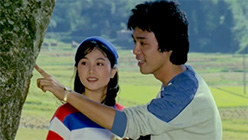 |
Co-author: Cristina Álvarez López Happy New Year Cute Girl was Hou Hsiao-hsien’s first feature. He came to direct it after several years experience of scriptwriting in the Taiwanese industry; the film demonstrates the levels of craft he had absorbed by that time – especially in story construction. Cute Girl is, above all, a romantic comedy, and one that is fully within the pop culture idiom of its era. It stars two popular singers from, respectively, Hong Kong and Taiwan: Kenny Bee plays Daigang, and Feng Fei Fei (known as the Queen of Hats) is Wenwen. At the start we hear an upbeat, sentimental duet sung by both of them, accompanying the characters’ first chance encounter amidst the crowded traffic of Taipei. What is romantic comedy, as a global film genre, all about? It underlines and draws out the connection, over the course of a narrative, between two characters who are destined to be together at the end. So, romantic comedies have both a plot dimension and a semantic dimension, and the latter dimension involves defining the characteristics and values that will bind these two, chosen people together. From the start of Cute Girl, Hou explores every possible way – through rhyming gestures and montage links – of making Daigang and Wenwen into mirrors of each other, and thus having a soulful, as yet only latent or potential, connection. What kinds of characters are they, and what do they stand for? In the case of Daigang, an important scene occurs, once again, in city traffic. The cheeky little orphan he has adopted, nicknamed Stone, happens to mention that Daigang’s father was a driving instructor, and thus of the working class. Meanwhile, the action of the scene itself is about the ability to play, to muck about in public, to lightly flaunt convention. In the case of Wenwen, we have a wealthy family, but a modern girl. She wants to have fun: she muses about having two lovers at once, mocks her parents’ rigidity, and identifies with her free-spirited Auntie. Above all, she craves freedom from such social conventions as an arranged marriage. She wants to follow the path of love, not that of financial responsibility and obligation to family. In a second major phase of the film, Wenwen heads out to the country. In his early works Hou will deal, several times over, with the comparison of city and country. The country stands for good living, a healthy sense of fun, and transparency, honesty, directness and authenticity in human relationships. Wenwen’s journey is marked by a second major pop song – Cute Girl is sometimes erroneously referred to as a musical because it is so song-saturated. More than anything for Hou, the country is the place where small children thrive. The next step in the romantic comedy schema of Cute Girl involves re-introducing Daigang to Wenwen, and putting them at odds. As a surveyor, he stands for the suspect city values of redevelopment, of soulless progress at all costs; while she is a jolly teacher figure, slinging the mud like any of the kids whom she minds. Daigang assumes Wenwen to be, as he says, “a country gal”. Next, they fall in love. Significantly, this happens in and around a tree. Trees play an important part in the story, as well as physically embodying country values. The affection between the characters is sparked by a typical series of rom-com coincidences, mishaps and accidents. But Wenwen is, in fact, a city girl. So, after their few days of innocent romantic bliss, Wenwen goes back to the city out of a sense of duty and reason, plus a suspicion that (as song lyrics tell us) happiness is only fleeting and destined to be a mere dream or memory. At a very public reception to announce the engagement of Wenwen to the third central character, Qian, Daigang is confronted with the class abyss, the difference in social standing, that divides them. Two-thirds of the way through this plot, Hou works an unusual twist: the seeming male rivals, Daigang and Qian, become best friends, and we are treated to a string of bromance (brotherly romance) jokes, such as the one where the shot pairs up the men on one side of the scene, and Wenwen and Stone, both of them bored and excluded, on the other side. In the midst of all this male camaraderie, the previously adored woman functions now as no more than shelter from the wind to help light their cigarettes. As in many romantic comedies, the resolution comes in finding an untroubled semantic middle-ground for everybody and everything. Qian willingly exits the story, and Wenwen is introduced to Daigang’s family. She then discovers that, not only does he really come from a wealthy family, but also her own parents have already arranged and approved this match. And recall that, earlier, Wenwen found herself defending, to her country friends, the positive good of rural redevelopment. Let’s look more closely at the comedy part of the romantic comedy equation. The visual gags in Cute Girl are broad, physical and enjoyably overstated. The camera zooms, the actors mug, and the intercutting of actions goes crazy. This comedy can also veer toward the vulgar in its discreet but definite references to lower bodily functions. In one scene, the brass instruments of the orchestra, plus military drums, mimic Daigang’s internal disorder and panic. The theme of communication – particularly the technological communication devices of the big, modern city – is a recurring topic of comedy here. Beyond the word plays and verbal misunderstandings of the dialogue as scripted by Hou, scenes of telephone conversations, tape recordings and the like are inherently cinematic in their possibilities. Hou uses reveals, like the zoom-out to show the guys in two adjacent booths; he plays with the doubling of the domestic phones and their contrasting red and white colours; he speeds up the tinny sound of voices coming through the receiver, like in a cartoon; he exploits bromantic misunderstanding, when the guys appear to blow kisses at each other; and he substitutes the gruff father for the peeved Wenwen for the final cap-off of a joke. Although Hou frequently uses a signature pop cinema device of its time – the zoom lens, out and in, to unfussily reframe scenes and emphasise key details – there are also some premonitions of the elaborate Hou style that will evolve later in his career. There is, for example, a long take in which Hou arranges more than 20 bodies in the wide frame, constantly reordering them through the action in the mise en scène, and through movement of the camera lens. The long take, via clever framing and staging, can also be used for comic effect. The Auntie – a central mediating character between the semantic values of city and country – is positioned in such a way in the composition that we observe, most of all, her gestures of listening, playing coy, leaning in, intervening in the couple’s intimacy, and even at one point looking beyond the frame to register her superior understanding of the entire game of the romantic comedy schema as it moves toward its resolution. Just as Wenwen and Daigang first fell in love around a tree, so too does this romantic comedy progressively knit itself together through a thread of vignettes involving a special tree: a sacred Lovers’ Tree, as it is called – part of a rich, verdant, sunny landscape. First, Daigang carves his initials in it, but Wenwen refuses. Later, upon leaving the village, Wenwen returns, impulsively, all alone, and adds her name as well. This is part and parcel of the film’s sentimental, pop song code: even in sadness and apparent defeat, one must leave a trace, a declaration of one’s impossible love. The conclusion pulls a surprise reversal. Wenwen storms off in anger and Daigang follows, to placate her. There is a cut, and this same action seemingly continues, with the actors wearing the same clothes – but, in fact, the edit has whisked us back to the country, and into the future, with Wenwen pregnant, and the Lovers’ Tree revealed, in a zoom-out, as the emblem of their marital happiness. The American magazine Reverse Shot once declared that “it can be embarrassing to watch Hou stumble through the pale genre exercises” of his early films, and that “it is awkward and a bit absurd to hold such films up under the auteurist microscope”. But there is really no need to apologise for Cute Girl, or any of Hou’s early works. Working within popular conventions, Hou displays both a solid grasp of storytelling craft, and the beginning of his prodigious and lifelong cinematic inventiveness. This text is a version of the voice-over narration composed for an audiovisual essay included in the Belgian Cinematek DVD boxset Hou Hsiao-hsien Early Works (2015) and re-used by Carlotta for their French boxset Hou Hsiao-hsien 6 œuvres de jeunesse (2017). MORE Hou: Good Men, Good Women, Millennium Mambo, The Boys from Fengkuei, Three Times © Cristina Álvarez López & Adrian Martin August 2015 |

 , aka Lovable You, Hou Hsiao-hsien, Taiwan, 1980)
