|
 |
 |
 |


|
|
|

|
Léonor
|
 |
|
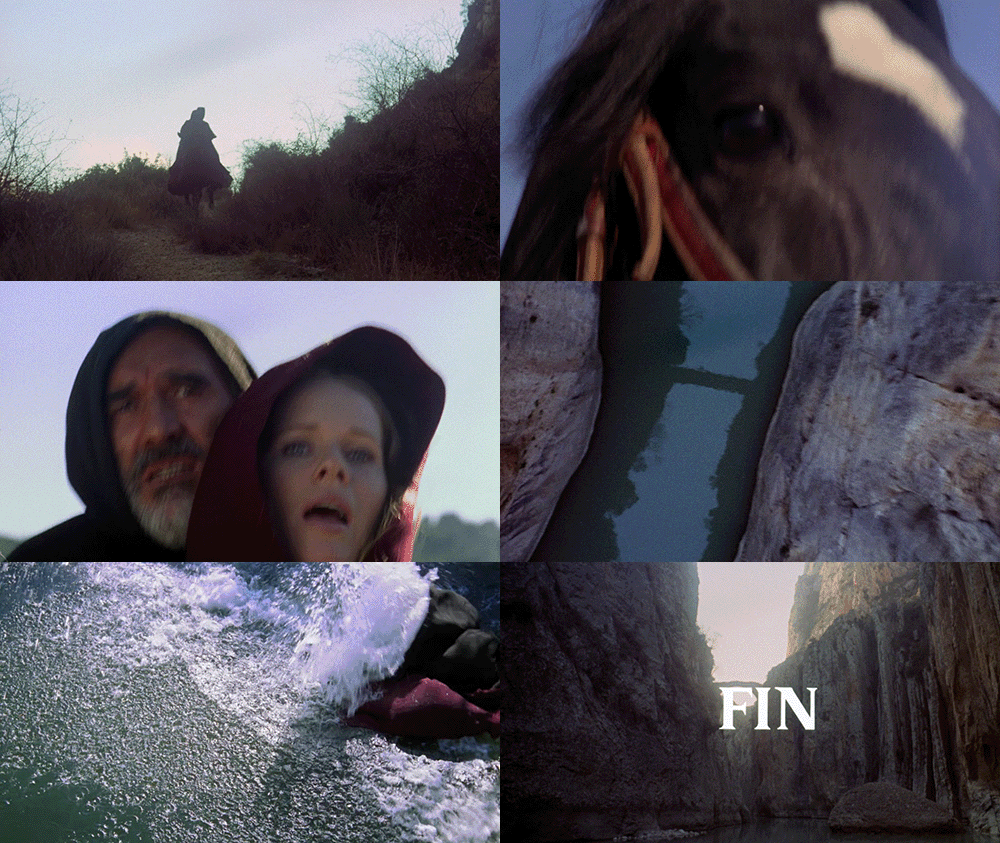
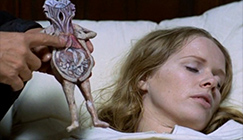
It cannot have been an easy career road for Juan Luis Buñuel (1934-2017), labouring in the shadow of his father. And not simply with the memory of the latter’s golden days of the 1920s or 1960s, either; exactly at the moment that the son made what would turn to be his final theatrical feature (before shuffling over to French television work), Dad was living through the grand, global resurgence of his three ‘70s monster-hits (The Discreet Charm of the Bourgeoisie [1972], The Phantom of Liberty [1974] and That Obscure Object of Desire [1977]). No wonder that Juan’s films have such a spooky attitude to family inheritances of various kinds – inheritances subject to various curses. Léonor (I presume the accent only holds for the French release) is this early ‘swan song’ of Juan Luis Buñuel’s feature film career, when he was just past 40. (He later directed episodes of a Fantômas retread for French TV in alternation with Claude Chabrol.) It’s his third film in a row to explore various shades of the fantastique, after Au rendez-vous de la mort joyeuse (aka Expulsion of the Devil, 1973) and La Femme aux bottes rouges (1974). Buñuel Sr’s genial collaborator Jean-Claude Carrière helped out on the scripts, including (uncredited) the third; actors familiar from the father’s hits (Michel Piccoli, Catherine Deneuve, Fernando Rey) duly take up their appointed, frequently enigmatic, shape-shifting roles. Léonor is an adaptation – largely faithful to the main lines of original, while cleverly swapping around several plot articulations and adding significant contextual elements – of the 1823 short story “Wake Not the Dead” by Ernst Raupach (sometimes misattributed – including by the film’s credits! – to Ludwig Tieck). It begins in medias res with Richard (Piccoli) – soon revealed to be some vague sort of aristocrat/nobleman with nothing much to do – gutting enemies with his vicious swordplay out in a rocky plein air. This spectacle sets up not only the character’s physical strength and skills (which will be central to later events) but also his gruff habit of listening to nobody and refusing all offered assistance – an unlovely solipsism that will eventually lead him into some strange abismos de pasión, indeed. The milieu that the film sketches around Richard is sparse, silent, frequently empty. The real world is elsewhere – but, in the form of a terrible plague, it will one day be arriving (literally) on the wind. This sets up a fascinating, tripled ambiguity: is what we witness the result of spiritism, of madness, or of external, material forces? It’s intriguing to see a film of 1975 play on this vacillation in such an understated way (it is hardly addressed at all within the characters’ dialogue), in comparison with similar narrative conceits handled in future years by John Carpenter or Jeff Nichols. The spirit angle arises in relation to Richard’s first wife, Léonor. When we first meet her, she’s already in a seeming coma – and (a Carrière touch?) the blood-draining medical practices of the time only hasten her departure from the mortal coil. Since she’s dead within the first few minutes, any joker would quip aloud: what a simple, wordless cameo that was for Liv Ullmann! But soon she is drifting through the background of shots in which Richard paces, or flickering as a momentary apparition in the distance across a lake … So Richard, in a Vertigo-type seizure (many studies have linked Hitchcock’s film to deep traditions of German Romanticism and French Gothic), finds a way, via a mysterious shamanic figure, to resurrect Catherine. And, in this undead state (not exactly a ‘mistress of the devil’!) – with a flesh that is no longer her own, unless she can revive it, Bathory-like, with youthful blood – Ullmann excels at conjuring her ethereal character in spooky but also perfectly natural movements, gestures and gazes (those piercing, uncanny blue eyes!). It had me flashing forward to Philippe Garrel’s take on Théophile Gautier in Frontier of Dawn (2008). And Buñuel’s erotic angle is discreet but telling: this odd couple falling to the ground to make love while surrounded by the farm flock of sheep is only one of very many images intertwining humans with the animal and insect realms. (I know, I know, Luis B. incorporated a lot of that stuff in his work, too – but here it really has a peculiar force unique to the project, it’s not just grossly decorative or a cinephilic wink to the initiated.) Léonor is built on an astonishing system of ellipses. The spectator is constantly tripped up by these leaps in time, demanding an instant recalculation of their comprehension of unfolding events. Richard, immediately after Léonor’s death, is about to marry the (seemingly very) young Catherine (Ornella Muti was 20 at the time, Piccoli 50) – it is hard not to recall the proudly incestuous delirium of Piccoli in Themroc, released only two years earlier – but Buñuel skips the trifling incident of the nuptials. He first shows Richard wandering and brooding in the fields, and then the girl puzzled – so now it becomes clear that this is situated some days later – by the non-consummation of their union. Later, the scene of Léonor’s taking of her first victim (an intriguingly, even disconcertingly non-graphic and indirect scene) is instantly followed by news that the tally of dead children has reached eight; Buñuel has zapped out the iterations. At certain moments, ellipses contract into swiftly dispatched off-screen events, such as Richard’s slaughter of the horse that effectively killed Léonor. The minimalistic logic would seem to be: whatever is easily imagined (within narrative logic or generic convention) does not need to be depicted. It’s reminiscent of the American B cinema tactics of, say, Irving Lerner. But there are other, equally expressive uses of Léonor’s non-dealing with typical plot questions – such as the apparent absence of any quasi-maternal contact between the resurrected Léonor and Richard’s two children from Catherine. (The pay-off on that one is grim but satisfying.) Throughout, Buñuel Jr plays down conventional horror tropes and avoids, particularly, any standard opportunities for displaying sadism, protracted acts of violence, or literal gore. The poetic, lyrical effects common to the best gialli or Roger Corman’s Poe adaptations are here concentrated in the lighting (Luciano Tovoli is the illustrious cinematographer), and the roomy, tableau-like arrangements of figures within the Spanish locations (landscapes and castles) – as well as in Ennio Morricone’s remarkably dissonant score, which sometimes sounds like two or three different pieces laid atop each other. This enormous, deliberate restraint on the film’s part leads to an especially surprising treatment of the tale’s end (even given the obvious need to shoot the scene with a stunt person rather than the stars): in the flurry of shots that show the death-driven couple’s plunge into the water off a scenic bridge, apart from one repeated insert two-shot, neither of their bodies/faces is scarcely visible! (The horse becomes the real star.) Juan Luis Buñuel, or the Cinema of Disincarnation …
© Adrian Martin 17 November 2025 |