 |
 |
 |
 |


|
|
|

|
Un monde sans pitié
|
 |
|
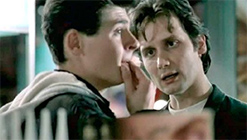
Un monde sans pitié is usually regarded as the inaugural film of the jeune cinéma français (JCF) or ‘young French cinema’ phenomenon of the 1990s – for a general definition and discussion, see here. I decided, for research purposes, to do a revisit, having first seen it 35 years previously at an Australian arthouse cinema (the Valhalla); my dim memory maintained a certain melancholic, New Romantic aura around it (and its vaguely Freewheelin’ Bob Dylan-cover poster!). It’s directed by Éric Rochant (later destined for TV success with The Bureau [2015-2020]), with a script contribution by his friend and colleague Arnaud Desplechin. (Another prime JCF auteur, Noémie Lvovsky, at this time making her first shorts at Fémis, can be spotted as an extra.) The film’s constitutive elements announce themselves brashly: driving, upbeat ‘80s techno-flavoured score; a callow, louche hero (Hippolyte Giradot) who plays with the emotions of his various lovers (including an older woman, as in so many French films post Jean Eustache’s La maman et la putain [1973]); the post-Nouvelle vague rendering of streets, bars, cramped domestic parties. There’s an especially American touch added, thanks to Rochant’s and Desplechin’s worship of the ‘80s output of Scorsese and Coppola (if not quite John Hughes!) – a taste which, as students, put them at odds with their strait-laced professors at IDHEC. Theirs was an aesthetic that Raymond Durgnat once called energy realism, something Desplechin continues to pursue today in his work, via the specific lessons in economy and speed mastered by François Truffaut. At certain points of Un monde sans pitié, in fact, you could almost be watching Michael J. Fox in Herbert Ross’ The Secret of My Success (1987). But there’s also a large dose of influence from Leos Carax’s vivacious Boy Meets Girl (1984), not least in the casting of Mireille Perrier as the hard-to-get-and-keep lover. Viewed today, there’s something a little too easy about Un monde sans pitié (I haven’t yet gone back to check whether this little something annoyed any of its reviewers at the time). Not once but twice we are given to hear a ‘no future’ soliloquy by Hippolyte that is more blasé than punk; the ‘political debates’ between Communists and others are a pale socio-cultural mirror of the times; the strada (very Woody Allen-ish) running from hero-as-shit to remorseful man of compassion and empathy is too quickly and painlessly engineered; the comedic bits (USA entertainment credo, again) are sometimes rather forced. That said, the denouement of Hippolyte hiding on the parapet outside his room while his older lover angrily waits inside – until the phone rings, forcing him to re-enter the space to take Perrier’s call – is a winner. (Maybe that explains my fuzzily auratic memory of the entire film!) The subsequent airport finale had me free-associating ahead to a generally underrated (critically speaking) feat of cine-mechanics that I feel sure was influenced by Rochant’s work here: namely, Gilles Mimouni’s The Apartment (1996). MORE Rochant: The Patriots © Adrian Martin 3 August 2025 |


