 |
 |
 |
 |


|
|
|

|
The Pick-Up Artist
|
 |
|
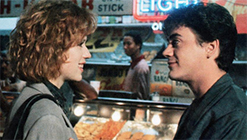
James Toback’s The Pick-Up Artist arrived in Australian cinemas at the same moment as Joe Dante’s Innerspace (1987), and there are many reasons a critic like me would choose to interrelate them. Both are lesser works by directors who are almost always fascinating, and have at least once in their careers thus far produced brilliant, unforgettable films – Gremlins (1984) and Fingers (1978), respectively. Both of these 1987 releases can be imagined as having once been wilder, tougher, less compromised projects – subject to the same film industry forces that elicit The Color of Money (1986) from Martin Scorsese or The Untouchables (1987) from Brian De Palma. And, looming behind each of these new films, at the dark heart of compromise, is a powerful, charismatic, tutelary producer figure – Steven Spielberg for Dante and Warren Beatty for Toback. (Beatty’s name does not appear in the credits of The Pick-Up Artist, but his decisive role in the production is colourfully outlined in David Thomson’s Beatty biography.) The Pick-Up Artist is an altogether happier affair than Innerspace – if similarly uncertain in spots. It started out six or so years previously as – believe it or not – a drama about “a man who wants to fuck every woman but who still lives with his mother”. On reporting this in 1981, David Thomson (in his book Overexposures) remarked that “Toback might be the filmmaker to reveal how much the American male longs to screw his mother. Wouldn’t that have to be an underground picture?” As it turns out, The Pick-Up Artist is no underground picture. The mind boggles as to the intervening turnarounds and rewrites on that initial script – a project entirely in line with the tortured, narcissistic angst laid out in every preceding Toback film (The Gambler [Karel Reisz 1974] which he only wrote and then Fingers, Love and Money [1982] and Exposed [1983]). In the film as completed, the mother has metamorphosed into a grandmother, Nellie (Mildred Dunnock in her final screen role), and any sexual tension between her and the 20 year-old hero is entirely absent; in fact, the old dear seems to be still happily pursuing her own, utterly independent love-life. If this is a James Toback film, then Toback must be a changed man! Actually, it’s hard to tell how sincere or how calculatedly mature Toback is being here. Every obsessive Toback trait is present somewhere: alcohol, gambling, vicious compulsion, psychological double-binds, driven sex. Yet, instead of being compounded all into the main character (always a Toback stand-in), here the traits are spread around, shared, worked through without any particularly violent catharsis: the hero, Jack (Robert Downey Jr), womanises; the woman he meets, Randy (Molly Ringwald), gambles; her father, Flash (Dennis Hopper), drinks. Something of the characteristic Toback male-centred, Oedipal intrigue lingers in the plot – Harvey Keitel as Alonzo Scolara, the criminal father-figure who must be transgressed in order for the hero to win the woman-object from his clutches – but here, for the first time, the woman is not an object; she has something to say and reciprocate. (A distinct advance on Exposed, where Toback merely foisted his trademarked neurotic formation upon Nastassja Kinski as a female hero.) I haven’t yet mentioned that The Pick-Up Artist is a comedy. Toback’s humour had previously been of the particularly grim, dark kind; here, he joins the trend of lightweight films trying to take teen stars (like Ringwald) and teen movie styles into a new genre of young adulthood. Toback sometimes appears ill at ease with both a hero not his own age and the mechanics of light comedy. This is where some of the uncertainties and confusing overlays appear: why must this hero be an obligatory Toback alter ego with a love of doo-wop music? Many of the on-going comedic premises – such as Jack and his best friend Phil (Danny Aiello) never stopping to deduce that Flash is Randy’s dad – are delivered heavily and somewhat implausibly (Toback is neither Rob Reiner nor John Hughes with this material). When Toback tries to flip his typical signature scenes – such as when the failing hero tries to bluff his way out of a tight spot and fails miserably (see Fingers) – into positive, happy, triumphant moments, it only ever half works. Despite such problems of tone, there is much good news in The Pick-Up Artist. Toback’s filmic style has previously lurched from excessive experiment (the relentless long takes in Exposed) to flat narration (Love and Money). He’s discovered some fine new wrinkles here; in particular, a stunningly expressive use of locations (subways, car parks, hotels, Coney Island). When he can bear to tear the same old doo-wop off the soundtrack, Toback invents some startling image-sound rhythms and relations involving (amongst other things) rap and funk music – “Casanova” by LeVert is used particularly well and brightly. Theme-wise, Toback explores with full strength what has always been his special interest – the relations of main characters to their taciturn, highly individualised parents – and uncovers an affinity with complex ideas in the great 1940s romantic comedies. In this regard, The Pick-Up Artist evokes both Leo McCarey – the two principal characters having both to learn something and give up something, finding the mid-point between playing too much and not being able to play enough – and George Cukor. What with Randy having to move beyond a certain frigid emotional (not sexual) reserve and the womb-like relationship with a loving (not tyrannical) parent – The Pick-Up Artist is a little like Toback’s version of Cukor’s The Philadelphia Story (1940). Don’t believe me? Well, check it out – and pay strict attention to that grandmother. Postscript 2026: When I rewatched this film in 2015 after a long absence from it, I found it a total joy, scarcely plagued by the various “problems of tone” that I had perceived back in 1987. In retrospect, one can see that it set an altered pattern for Toback’s work – leaning more to teen movie conventions – pursued in Two Girls and a Guy (1997) and especially Harvard Man (2001). My most extensive consideration of Toback’s career as a whole – before his ignominious fall from “indie” grace in 2017 – appears in the book The Last Great American Picture Show (Amsterdam University Press, 2004). MORE Toback: Black and White, The Big Bang © Adrian Martin November 1987 (+ update May 2026) |


