|
 |
 |
 |


|
|
|

|
Reality
|
 |
|
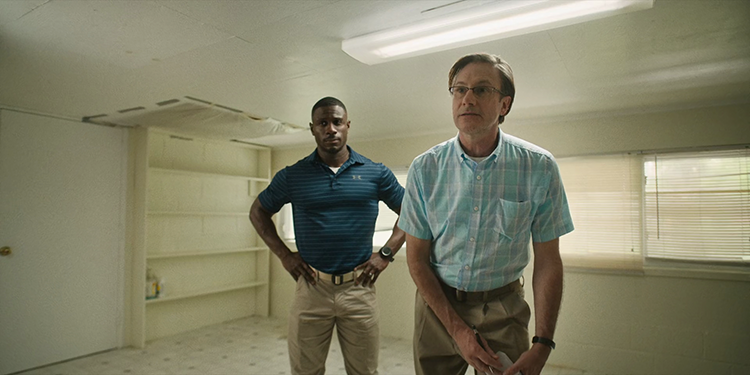
Reality Hunger A phrase became popular among film critics and scholars in the mid 1980s: the line between documentary and fiction. The point of it being that this line often proves extremely difficult to draw within particular films – and impossible to rigidly define as a general, theoretical principle of cinema. The line keeps shifting, wildly, and has never ceased doing so. The initial impetus for this probe in the ‘80s came from the striking appearance of a new kind of essay-film associated with, to take a prime example, the work of Jean-Pierre Gorin (Poto and Cabengo [1980] and Routine Pleasures [1986]) – highly discursive films navigating between stylised treatments of documentary footage and other, more staged material, including a liberal use of clips/quotations from other films, and all driven by a witty and erudite voice-over narration from Gorin himself. But there were other paths evident in what filmmakers were doing, and how they were broaching this seductive space between documentary and fiction. In Australia, the experimental, unflinching psychodramas of Peter Tammer – patiently filming an old soldier recalling (and re-living) his wartime experiences (Journey to the End of Night, 1982), or an actor losing himself within a role (Fear of the Dark, 1985) – were filled with an intense, moment-to-moment fictional intrigue, even as the basic set-up revealed its staged (or prompted) artificiality. In the literary world of 2010, David Shield’s manifesto Reality Hunger caused a stir by calling for greater and more disconcerting injections of ‘raw’ reality – through, for instance, the use of bald appropriation – into hybrid prose forms. In cinema, television, and video art, such reality hunger latched onto a somewhat different desire: a yearning for the textures of reality – open-ended time duration, unframed takes, microscopically observed behavioural traits, improvisation and unforeseeable happenings – in a way that radically dissolved the usual priorities of fiction (such as closure, focus on a central figure, and emotional identification with characters). The vast genre of Reality TV adopted, for better and for worse, this same desire for openness – while circumscribing it within ever-more rigid and repetitive televisual formats. Even traditional arthouse distribution picked up on and reflected the reality hunger trend, in the case of, for instance, Harmony Korine’s Gummo (1997) – in which the notion of consensus reality as lived by the majority of citizens was provocatively skewed in the direction of an underclass comprising the disabled, the mentally ill, the perverse and grotesque … yet with Linda Manz from Malick’s Days of Heaven (1978) starring right in the middle of it all! None of this was entirely new, of course. The psychodramas of John Cassavetes, Norman Mailer, or (in his early phase) Robert Kramer had already jazzily blurred the line between documentary and fiction. Jean-Luc Godard, Agnès Varda, Chris Marker and Joris Ivens had pioneered sophisticated essayistic forms (and would continue to do so until their dying days). Frederick Wiseman declared that he intended his documentaries to be every bit as enthralling, structured and stylised as fictional films. And, every time we went back to it with fresh eyes, we realised that Man with a Movie Camera (1929) by Dziga Vertov and his collaborators proved ever-relevant to every hybrid that was blooming on the audiovisual horizon. One of the significant moments in the subsequent history of this entire discussion, and its reflection in filmmaking practice, coalesced around the notion of re-enactment. From Peter Watkins’ imagining of TV-style reportage crews anachronistically roaming the scenes of historic events (Edvard Munch [1974], La Commune [2000]) to the œuvre of Elisabeth Subrin (Shulie [1997], Maria Schneider, 1983 [2022]), re-enactment frequently opened up a double referent: a real event was alluded to and even minutely recreated but, at the same time, layered upon it was the recreation of a media artefact, in all its technological and material details: camera lenses, film stock or video tape, sound recording and mixing practices. The films of Errol Morris, Oliver Stone (particularly JFK [1991]), and subsequently much non-fiction TV programming (especially in the True Crime genre), took up this mode of depiction. On a quieter and less spectacular level, another kind of re-enactment was passed along from Robert Bresson (particularly in The Trial of Joan of Arc, 1962) to others including Marcel Hanoun and Danièle Huillet & Jean-Marie Straub: the recital or literal reading-out of a published text – including by its own author, as in the case of Franco Fortini in Fortini/Cani (1976) – enacts another way of placing words into a mise en scène of their passage through history. In recent times, Tina Satter’s Reality marks one of the most intriguing incursions of mainstream cinema onto the terrain of the shifting line between documentary and fiction. In its scope and texture it has the feel of a typical ‘American independent’ production; but it received the support of actor Sydney Sweeney, who takes the leading role, and enjoyed a wide release that spanned film festivals, theatrical venues and TV streaming (HBO). Reality has effortlessly attracted many different, even conflicting genre
labels: thriller, true crime drama, political essay, an exercise in
Lynchian surrealism, conceptual art re-enactment, a real-life
reiteration of Franz Kafka’s 1925 novel The
Trial … Reality,
it would seem, managed to successfully exist between many lines, and
to maintain its equilibrium among them.
The
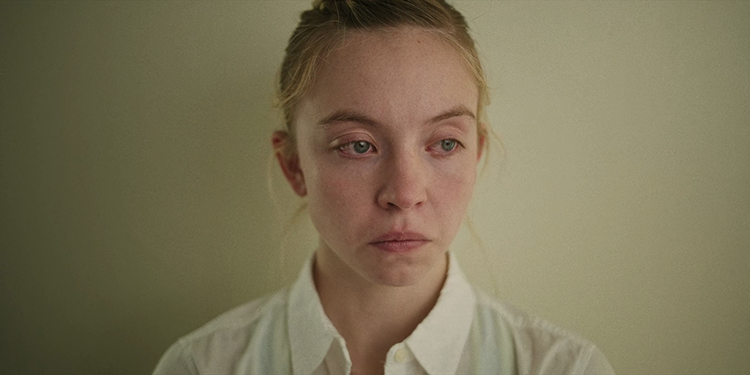
film imaginatively recreates a fateful day in the life of then
26-year-old Reality Winner, employed, at a high level of security
clearance, by the National Security Agency (NSA) of the United
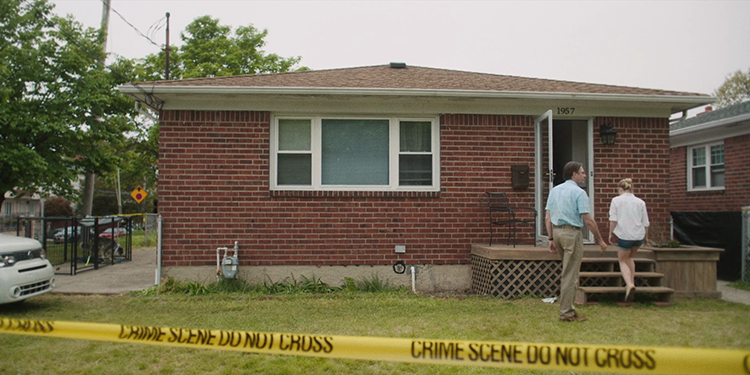
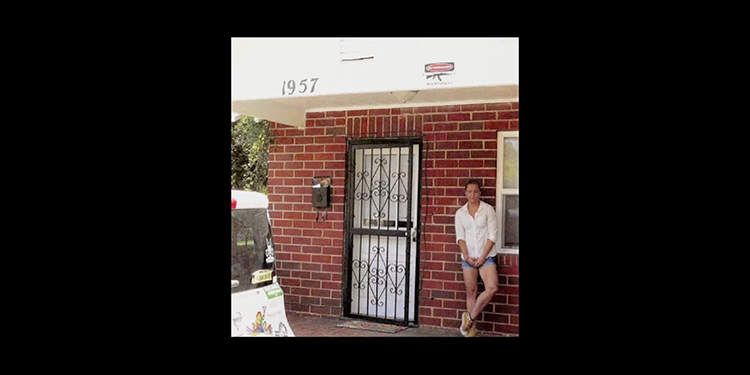
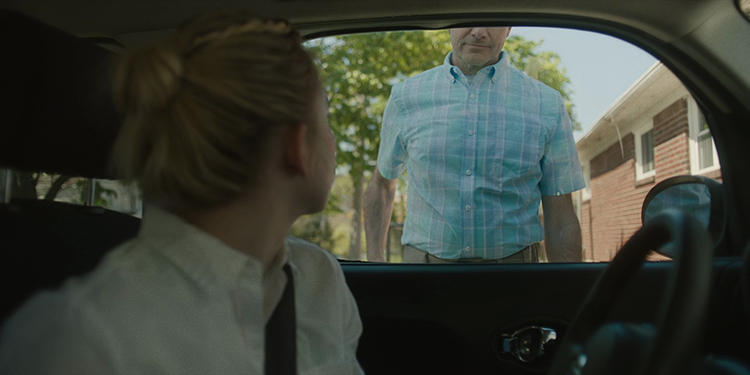
States. On 3 June 2017, Reality was greeted outside her house in
Augusta, Georgia by two FBI agents, Garrick and Taylor, who were soon
joined by a team of their associates. Armed with an official warrant,
the team undertook an extensive search of her home, car, devices and
belongings. As it takes Garrick and Taylor a while to divulge, they
have arrived with already compelling evidence that, during the
previous month, Reality leaked (via old-fashioned postage) a
confidential NSA report concerning Russian tampering in the 2016 US
election to a left-wing online news outlet, The
Intercept.
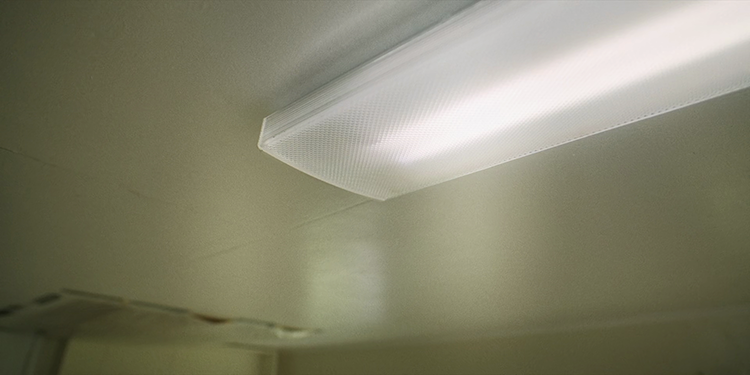
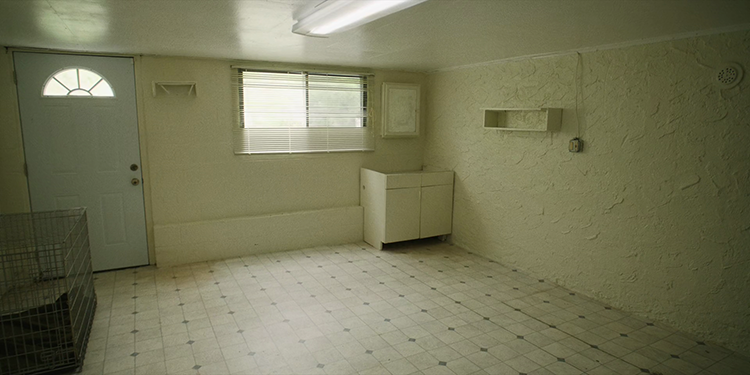
The entire time, from the first moment of this encounter to eventual arrest of Reality (when a female agent turns up for the body search), the agents recorded everything on digital audio – because even the most seemingly banal or innocent exchange between the officers and the subject was part of a complex interrogation process. The longest and most intense section of this veritable inquisition takes place in a bare ‘spare room’ that Reality hardly uses from day to day. [Update note: This spare room, as art-directed in Satter’s film, bears an uncanny resemblance to the eerie parallel-world of Kane Parsons’ Backrooms (2026)!] Consequent to her arrest, Reality was sentenced to five years and three months in federal prison. The case became, in the public sphere, a magnet for rampant debates about
the necessity of civilian whistleblowing versus the (assumed)
evil of betraying the nation.
In
2019, theatre artist Tina Satter premiered, at New York’s famed
venue The Kitchen, her stage production known in full as IS
THIS A ROOM: Reality Winner Verbatim Transcription.
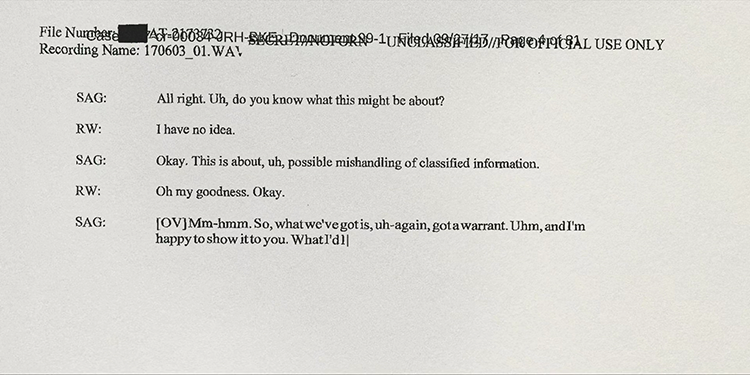
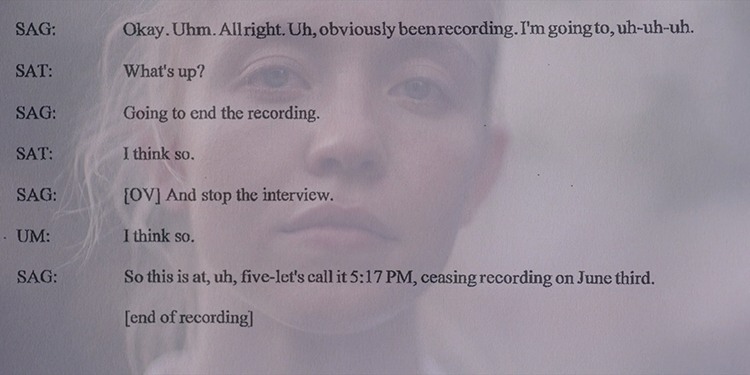
The performance was entirely derived from the official FBI
transcription of the audio file from 3 June – acted out solely on
the basis of whatever dialogue and stage directions (of a sort) were indicated in that text.
 Satter has declared that three things struck her from the first moment she read the transcript: that it begged to be performed aloud in one or many media (theatre, radio, film); that it inescapably evoked in her mind some well-known fiction films; and that a stylised convention of condensation employed by the transcriber – identifying all other agents at the scene, apart from Garrick and Taylor, as a single, undifferentiated ‘unknown male’ – was chilling in its offhand index of the patriarchal power bearing down upon a young woman under suspicion. Let’s pause on the greatest godsend of all for Satter, something so obvious that she almost never feels the need to mention it in interviews: the very name of Reality Winner! It is so pregnant with meanings (dramatic, conceptual, ironic) that it has served not only this film titled Reality, but a broader, more comically-inclined biopic named Winner (2024) directed by Susanna Fogel (Cat Person, 2023), plus a previous documentary portrait that puts the two pieces together: Reality Winner (2021). The project would thus appear, from the outset, to be anchored in true facts – or, at least, those facts as duly documented by the FBI and subsequently rehashed through multiple mass media reportage (a 60 Minutes segment, the documentary, podcasts, and so on). Satter – like Anna Broinowski in her lively exposé Forbidden Lie$ (2009) – is doubtless enough of a fan of F for Fake (1974), however, to have heeded the ambiguity at the heart of much non-fiction that Orson Welles centrally structured his film-essay upon: can we truly trust, should we really believe, the ‘objective’, authorial proclamations (such as TV’s favourite printed prologue: ‘based on a true story ….’) that a movie emblazons in its opening frames? For Reality will subsequently take (as Welles did) some remarkable liberties with its own premise. This
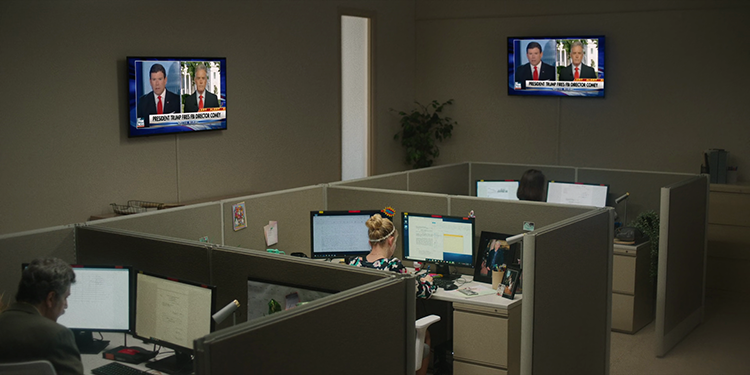
liberty is clear from the film’s very first shot – especially if
we pay forensic attention to the split-second way it concludes
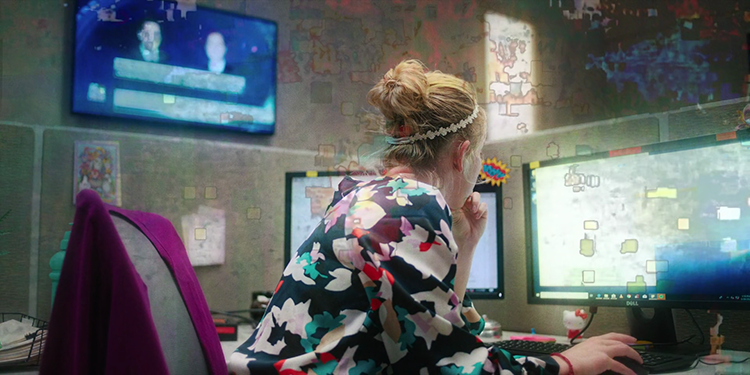
itself. Satter statically frames a working-day tableau in the manner
of Chantal Akerman, Kitty Green, or Cindy Sherman in Office
Killer (1997): a row of
cubicles, each person working on their computer, Reality (Sweeney) in the centre of the image …
but with the droning voices of the Fox News channel (reporting
specifically on Trump’s firing of FBI Director James Comey), beamed
on ubiquitous monitors on the office walls leading-in before the
image. It’s a neat encapsulation of a central theme that will be
explicitly discussed by the characters later: the ceaseless barrage
of media garbage that pushed Reality to her whistleblowing action.
But
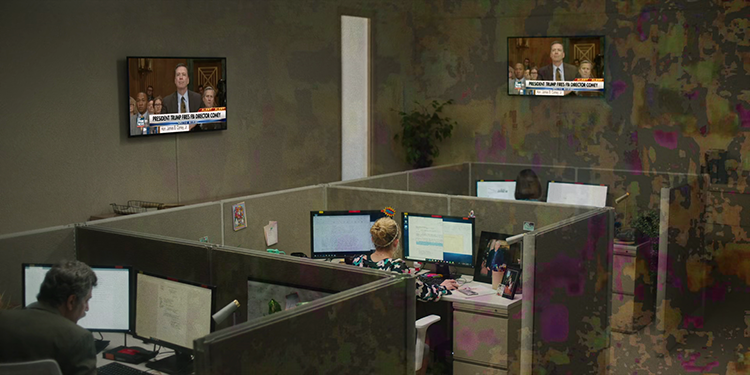
that’s not the most notable aspect of this prologue. Before it
switches to the intertitle ’25 days later’, the image flickers or
flashes for just a frame or two: a glitch effect has been fleetingly superimposed, giving it the familiar
feeling of digital decay or pixel breakdown. These glitch animations
– provided by the film’s production designer, Tommy Love – will
come to pervade the film.
This initial appearance of glitch has no apparent motivation in narrative or psychological terms (it will pick up these connotations later) but, in line with a major tendency in contemporary cinema, it introduces a subterranean corrosion of the status of reality that works on several levels simultaneously. In the digital era of fake news and other mindboggling distortions of the truth, the film sets out to show an event whose reality is unstable for everyone – both for those directly caught in its net, and all of us who subsequently consume it via media representations. I don’t know whether IS THIS A ROOM (the title is from a line spoken by one of the ‘unknown males’ as he pokes around Reality’s home) followed a rigorous real-time concept, but the film retains only the illusion or vibe of such a duration. While (like the play) respecting the self-imposed constraint of using only what is in the FBI transcript for the basic mise en scène, Satter’s screenplay (co-written with James Paul Dallas) uses, rather, blocks of the transcript with ellipses both between and within scenes (such as the poignant gag showing Reality’s cat roaming free, and then leashed up). Satter
frankly admits she grasped the thriller potential of the material –
its capacity to grab and hold the spectator – on first reading. To
that end, the film focuses on what Satter describes as the agonising
meltdown of Reality as she faces interrogation – and the gradual
realisation that her destiny has been forever altered by the events
of this day.
What
Anna Kornbluh has diagnosed as audiovisual culture’s version of
Shields’ reality hunger concept is evident in this arrangement of
the material. In her book Immediacy or,
the Style of Too Late Capitalism (2023), Kornbluh evokes many varieties of contemporary cultural
immersion – in a TV stream, in a virtual reality installation, in a
headlong or you-are-there
aesthetic (her key example is the Safdies’ Uncut
Gems [2019]). Satter, for her part,
wants us as spectators to be inside Reality’s consciousness, to
share her real-time crack-up – as she said to Why
Now magazine, “we can see parts of
Reality’s heart and her emotional map visualised”. (1) On this level, the glitches work as a visualisation of Reality’s
subjectivity.
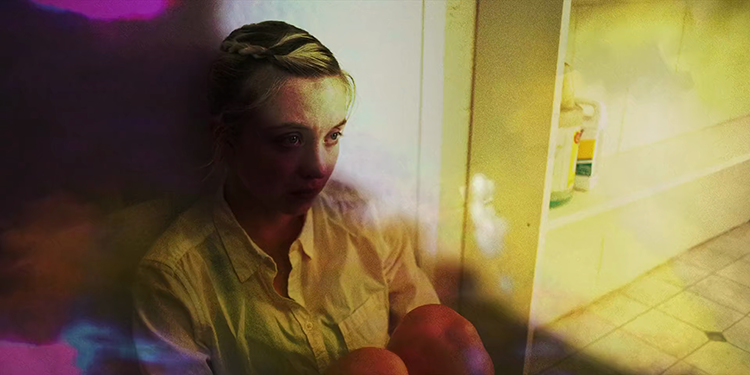 Satter
also aimed to achieve a particular balance in the texture of the
work. Referring to the occasional insertion of real FBI photos of
Reality from the day, as well as her personal photos and material
from her Instagram, Satter explains: “For me, it was always
important to get some of those edges of the real Reality in there,
but I never thought about it necessarily as a documentary … It’s
a narrative feature with these real edges, there’s no official
category”. (2)
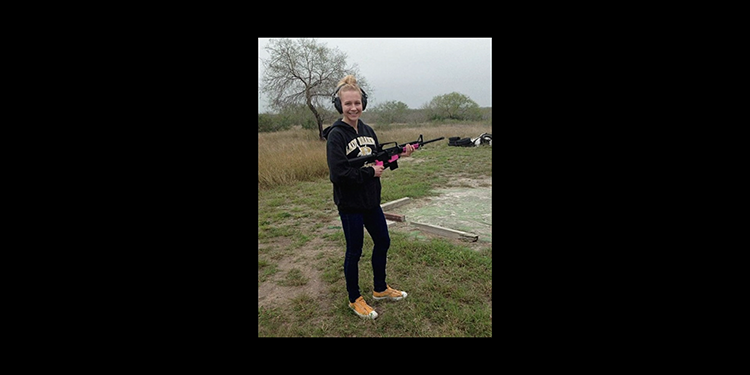 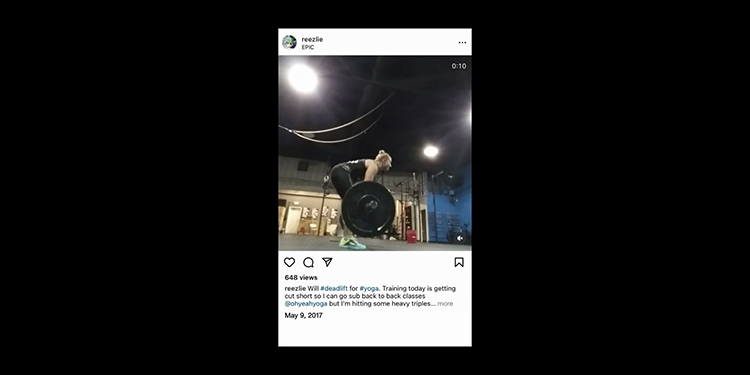 As
well as being a ‘narrative with real edges’, Reality serves also as a re-enactment with
strong fictional and cinematic resonances. The first time we see a
massed group of six FBI agents, it is hard not to recall the tense
POV shots from Clarice Starling’s perspective of a similarly
oppressive male grouping in Jonathan Demme’s The
Silence of the Lambs (1991). Satter has
indeed spoken of her project as an inverted thriller: no guns
handled, no shooting, chasing or killing – all dread is contained
within the acts of verbal interrogation and the subtle physical
containment of Reality.
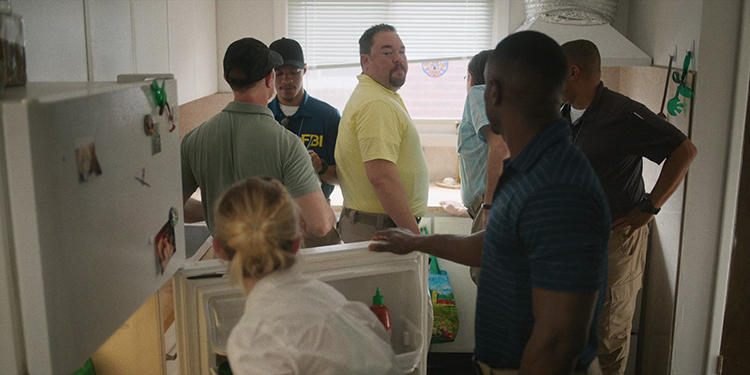 When
it comes to the shifting mise en scène of this restriction (Reality monitored outside the house, then
inside, finally outside again), there is a more elaborate trace of
the stylistics Welles used in the opening, virtuosic scene of The
Trial (1962) – bare room, wide angle
lens creating spatial distortion and distension of the space, a
choreography of bodies coercive and submissive, complete with sudden,
nutty intrusions from agents appearing and disappearing at doorways.
(3)
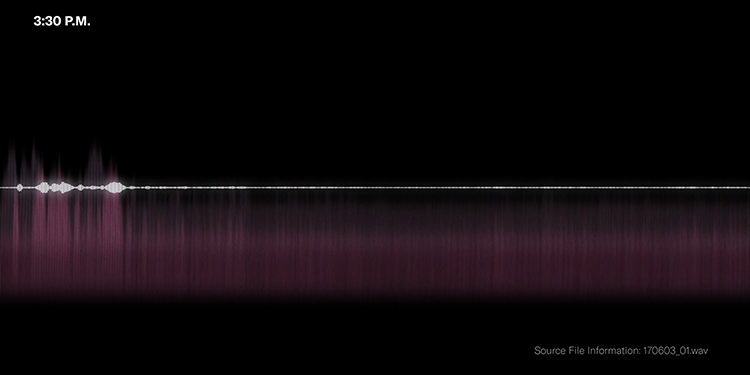
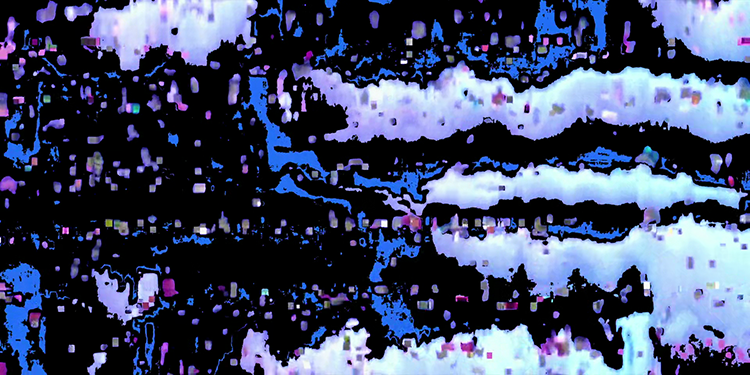
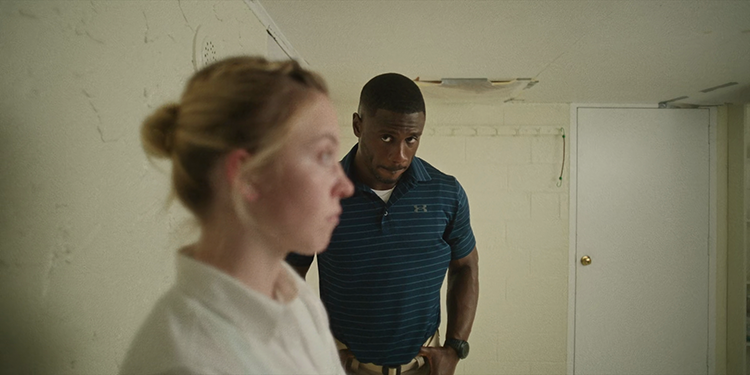 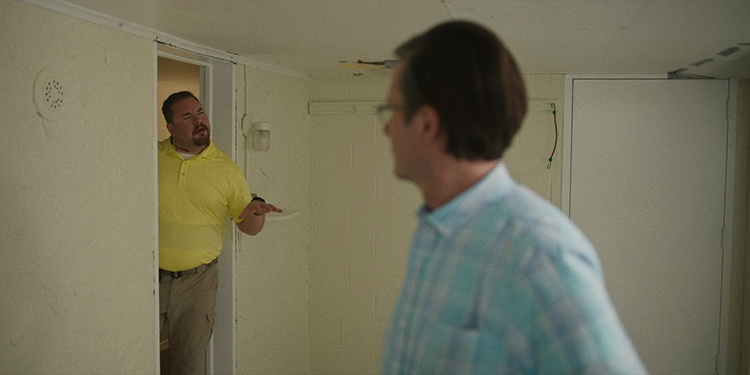 There is another level on which Reality becomes a reflexive commentary on the nature of acting and performance. As a re-enactment, Reality sticks to the FBI transcript but it also, of course, adds a great deal of interpretive material in that process: looks, gestures, postures, the characters shifting their weight, the precise timing of vocal delivery … not to mention everything that is generated by the découpage of the editing, and the addition of Nathan Micay’s generally minimal set of musical tones and booming sound effects – a compositional palette that is duly expanded only during the end credits. By the same token, however, we quickly come to suspect that what the principal FBI agents (Garrick is played by Josh Hamilton, Taylor by Marchánt Davis) were doing on that day constituted a pre- planned performance following a definite procedure: every relaxed joke, every stutter or stumble, every bit of everyday banter about pets or health, every solicitous gesture extended toward Reality, are part of a ‘script’. A former female FBI agent whom Satter interviewed for background research commented: “These kinds of visits, yes, it’s 100 percent acting”. (4) There are several artful turns in the dispositif set up by Reality. The documented transcript becomes the basis for a re-enacted mise en scène; and then – in a surprising move that can at first seem counter-intuitive – that recreated fiction then forms the basis for displayed pieces of documentary evidence that punctuate the scenes, seemingly to authenticate what we are seeing and hearing. This particularly occurs with the constant visualisation of a wav audio file – on which we hear not the original, real FBI recording (Satter claims she never listened to it), but an acoustically thinner version of the professional actors performing the scene. The audio illusion goes so far here as to cut between the sound of dogs barking within the filmed scene to the same noise continued in the wav file – a piece of realistic embroidery entirely added by Satter, since the FBI transcript makes no mention of such random, extraneous details. All the images of the wav file itself are, as it turns out, inventions of the film itself, just like its enactment in images and sounds. As often happens in cinema, it is this level of excess detail that guarantees the illusion of what Roland Barthes called the reality effect. Yet, on another level, Reality is devoted to drawing our attention, from the very first second, to the constructed, or more exactly unstable, nature of that illusion. Another level of the film that plays between seeming realism and expressive stylisation is its recreation of the process of redaction or censorship as displayed in the FBI transcript. We can note, throughout, familiar devices (now frequent TV clichés) that ‘bring alive’ static documents: the use of graphic animation to show, in real time as it were, the act of redaction (passages being blacked out), or the desktop documentary technique of seeing the words of the transcript as they appear typed, letter by letter. When it comes to missing, barred words (I wonder how these were signalled in the stage production?), Reality gets particularly inventive – and here is where we return to the matter of glitch. There is a subversive tradition in cinema that, as it were, plays along with censorship while also declaring it, to the spectator, as having occurred in precise spots. Jean-Luc Godard covered over censored, politically sensitive material with grating sound effects in several of his works of the mid to late 1960s. Luis Buñuel turned this same device into a running gag in The Discreet Charm of the Bourgeoisie (1972). In the marvellous, Godardian-style satire of militant cinema made by Canada’s Dave (or D.B.) Jones in Australia, Yackety Yack (1974), a freewheeling discussion (inspired by Norman Mailer’s Maidstone, 1970) among the cast members rebelling against their authoritarian director is shredded in the montage with jump cuts – indications that this (fictive) director has later edited out most of the criticisms against himself! Brian De Palma’s Iraq-set Redacted (2007) builds an elaborate, deconstructive conceit around censorship and its unmasking through fictive re-enactment. (5) Reality uses glitch to a similar end. This
animated special effect declares what is missing, leaving brief holes
– this becomes its narrative function. Not only do the spoken words
disappear, but also the bodies of the actors – in a puff of glitch.
The first time that it happens, well over 30 minutes in, is quite a
shock for the spectator. Something that is almost completely
invisible on screen has been revealed by Satter: that the glitches
are, in part, heavily processed from Fox News images – hence
looping back to their prefiguration in the very first shot. Satter
refers to this as the film’s “weird resident secret”.
 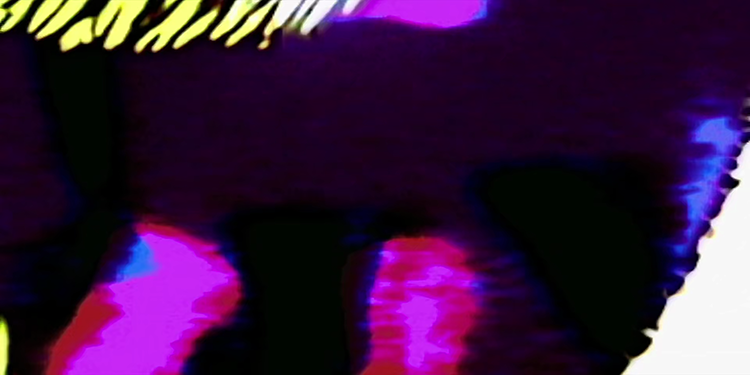 Let’s
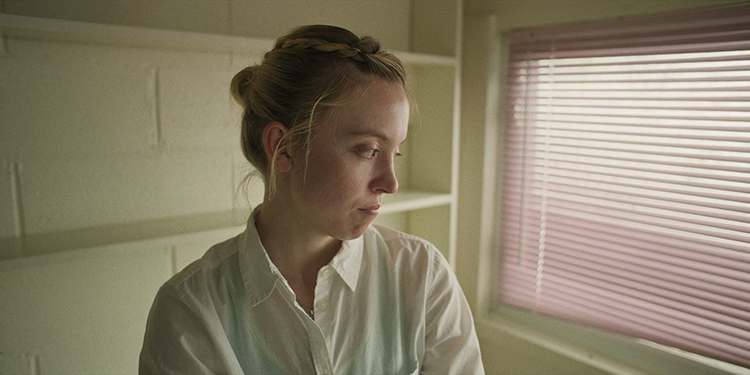
conclude on the colour pink. There is a
special form of colour coding used in the film’s overall design,
very logical, and systematic in its pattern, that is easy to miss on
a single viewing. It is based on the association of the character of
Reality with the colour pink (and
its family variations). Early details
casually link her to this supposedly ‘girly’ colour through Hello
Kitty-style objects, flowery writing paper, and so on. At a key
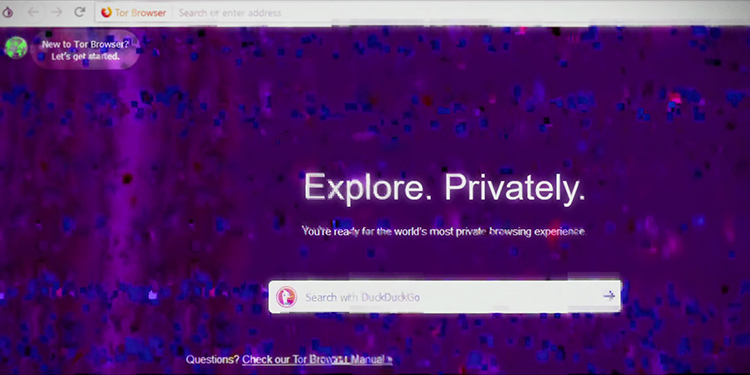
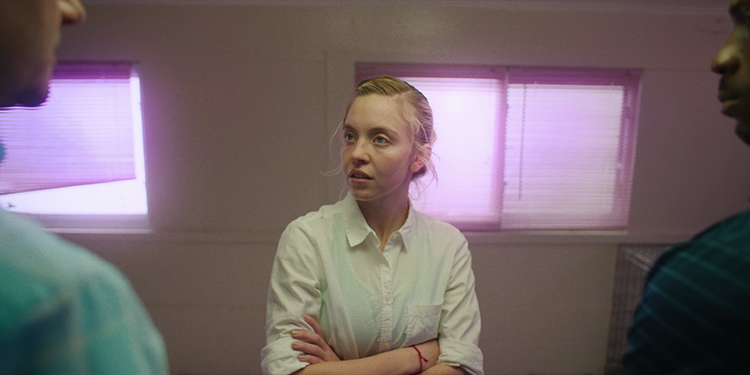
moment of stylistic switching 60 minutes in, however, Reality emerges
from a semi-conscious, dissociated haze (when she is watching a snail
on the window) to a clearly fantastic, subjectively imaginary
performance of tough self-assertion right in the faces of the FBI
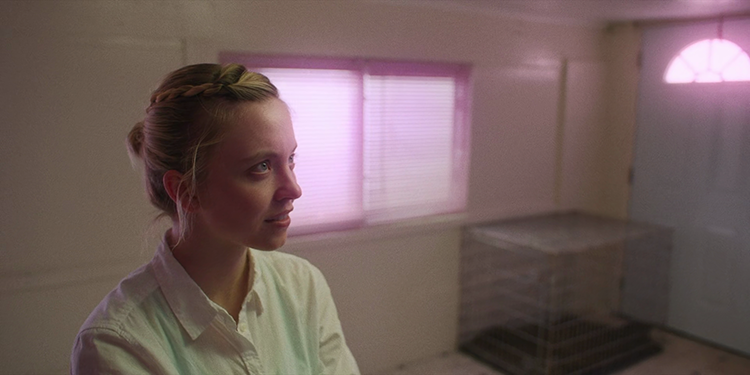
agents. The exact switch-point comes with the inserted shot of a Tor
browser page – in purple. Then there are, across the subsequent
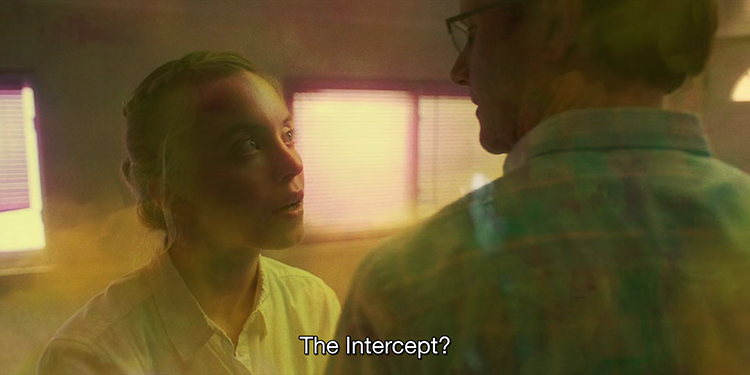
shots, a series of apparitions of pink. It is during this fantastical
interlude that Reality breaks the censorship regime that has been
simulated up to this point, by speaking the previously glitched-out
name of The Intercept.
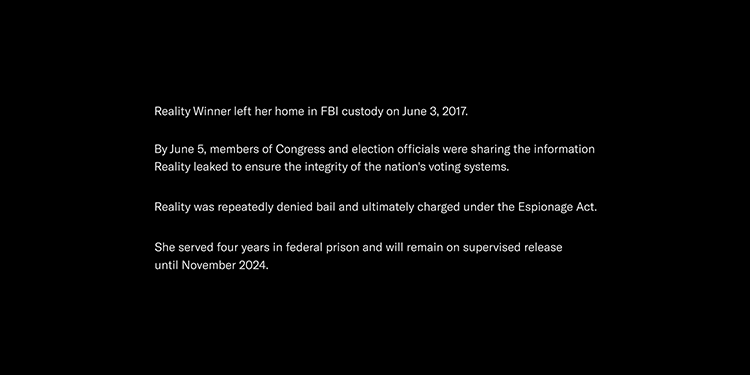
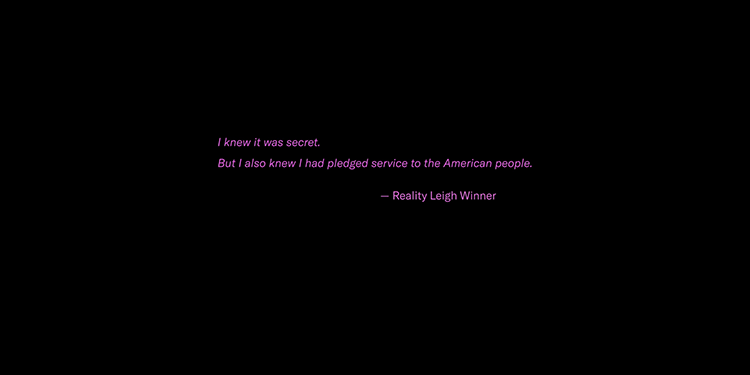
    When
we rewatch the film backwards and forwards from this scene, we see
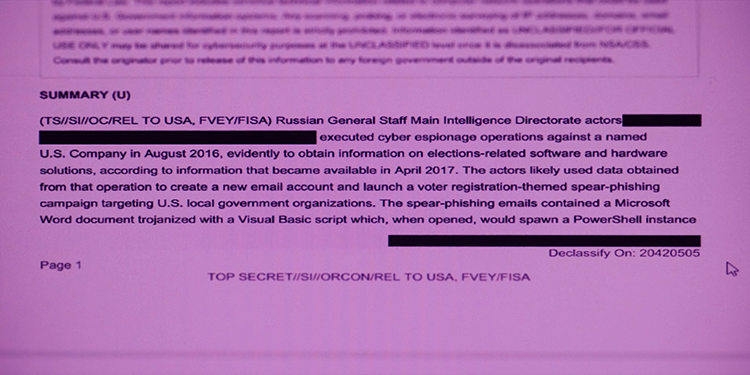
splashes of hot pink everywhere: for instance, in the NSA document
that Reality reads, and in the final intertitles – where Satter
passes from the usual white-on-black for objective, journalistic
facts to Reality’s own statement rendered in pink – and the
subsequent major credits also appear in this colour, as if in support
of her!
A
different version of this text appeared (in French and English) in
the inaugural issue of Fidback (FIDMarseille, October
2024), pp. 114-123, 185-188. My thanks to Cyril Neyrat for that invitation. NOTES 2. Lattila, ibid. back 3. Cristina Álvarez López and I made an audiovisual essay titled Reality Trial (2024) that intercuts moments from both films. View it here. back 4. Scott Macaulay, “Tina Satter”, Filmmaker, 2022. back 5.
For further elaboration, consult my DVD audio commentary on the 2026
Vinegar Syndrome edition of Redacted,
plus the chapter in the forthcoming book Do
We Love Brian De Palma Enough? (Sticking Place) by Cristina Álvarez López and myself. back © Adrian Martin August 2024 |