 |
 |
 |
 |


|
|
|

|
The Red and the White
|
 |
|
Co-author:
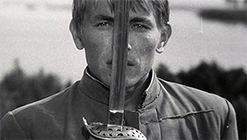
Cristina Álvarez López Relay The long take – long in duration, rather than in the distance between the camera and the action – is contemporary art cinema’s greatest fetish. As a fetish, it is frequently used without much thought for the craft of how to circumvent the problems that the technique typically introduces into almost any kind of mise en scène style or approach. Billy Wilder (on the set of Avanti! in 1972) was quite right (and eerily prophetic), already in 1972, to muse: “If I’d used a very long take it might perhaps have been admired by a few cinephiles, but the points in the characters’ conversation wouldn’t have been clear”. Today, we commonly associate the long take with a static camera and empty, dead time – each moment grinding away as life evaporates (see the cinema of Lav Diaz) – or with the steady, deliberately unaesthetic, often lateral follow-shot movements of camera and figures (Chantal Akerman did this best; many imitators fall far short of the mark she established). The latter variation, too, was briefly fetishised (especially in a Godardian phase) for exactly its planimetric flatness and dryness – and hence what Brian Henderson described as a ‘non-bourgeois camera style’! However, in an earlier era, the era of Miklós Jancsó in 1960s Hungary and Theo Angelopoulos in 1970s Greece, the long take was a more supple tool, exploited for many uses, moods and effects. In their work, the long take does not aim to detonate the (‘bourgeois’) concept of mise en scène, but to mesh with it. Variable, elastic distances between bodies, and between bodies and the camera; elaborate use of entries into and exits from the frame, in a systematic choreography; canny deployment of blocking or masking structures (such as walls or trees) in the scene … all this works together in often remarkable ways. And in a way that can introduce (when needed) temporal shifts or flights into fantasy. There is a lot happening in any, typical long take of Jancsó’s historical, political drama of the 1919 struggle between Hungarian Communists and Russian Cossacks, The Red and the White. The film is constructed in block-sequences – ten minutes or so within a fortress, by a river, or in the woods – and each of these elaborately, intensely choreographed blocks (sometimes involving dozens or hundreds of players) is usually broken down into a series of long takes. As viewers, we do not fixate on the time these shots eat up, because our attention is always being shunted elsewhere – as we discover a new configuration of characters, a new situation, a new portion of the space. Our audiovisual essay Relay (2017) opts to preserve a single take (from the fifth major sequence, 35 minutes into the film) in its 4-and-a-half-minute integrity; we add a DVD-style audio commentary. Relay is also viewable with subtitles in Simplified Chinese here. Because so much rushes by in the ceaseless movement of the camera, the players, and the treacherous events which sweep them up, we have also taken the opportunity to freeze some moments in screenshots so as to compare different phases of the take, and to provide systematic reference points from other, numbered sequence-blocks. Jancsó is a figure whose immense achievement has been obscured by relentlessly changing tastes and fashions in film culture. His nihilistic view of politics as an absurd game in which de-individualised characters ceaselessly swap sides, and swing from the position of abused to abuser (and frequently back again), is no easier or more comforting to swallow now than it was in the 1960s. But no one can doubt the extraordinary strides that Jancsó and his collaborators (including cinematographer Tamás Somló) took in forging a dynamic and complex aesthetic form based on the device of the long take. © Cristina Álvarez López & Adrian Martin January 2017 |


