 |
 |
 |
 |


|
|
|

|
Shoot the Moon
|
 |
|
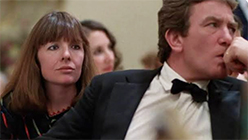
Shoot the Moon is unquestionably the best film Alan Parker (1944-2020) ever made – I haven’t seen them all (nor will I), but I feel absolutely certain in making that statement. It’s hard – probably impossible – to figure Parker out as any kind of auteur. Talk about uneven! There are films of quality (Pink Floyd – The Wall [1982]) and works of undoubted energy (Fame [1980]; The Commitments [1991]) … and then there are Evita (1996) and The Life of David Gale (2003), total shockers by any reckoning. Shoot the Moon is a singular project in Parker’s career: an intense drama about a family splitting apart, with echoes of the cinema of John Cassavetes (clinches) or Maurice Pialat (ellipses), but especially close to Paul Newman’s exquisitely balanced masterpiece The Effect of Gamma Rays on Man-in-the-Moon Marigolds (1972 – my audio commentary is on Indicator’s 2018 DVD). Parker had, by all accounts, a deep personal investment in the subject matter as scripted by Bo Goldman; intriguingly, he referred to it as less a story of divorce (which it painfully is, since that is what Parker was himself experiencing at the time) than an account of what divorce does to children. Those children – four girls – are indeed the key to what makes Shoot the Moon work so well. The adult leads – Diane Keaton as Faith and Albert Finney as George – are extraordinary, but Parker obviously realised that, for the project to function at all, the kids would need to be more than pesky, noisy ciphers on the edge of proceedings. He evidently worked very hard with the young actors to achieve both naturalness (so different to most movie-trained children) and a pleasingly stylised presentation of their speech and movement: at moments, there’s a quiet lyricism to their volatile group formations that trumps the fussy, refined stylings (in a similar pictorial vein) of Sofia Coppola’s The Virgin Suicides (1999, and still her best work). It takes a while, deliberately, for Shoot the Moon to show its hand as to what it’s really all about. The theme ultimately bursts out in a horrifying scene of George blowing his cool, rampaging through the family house (that is no longer his to share) and whacking his teenage daughter around. The mixture of violence and intimacy here (it culminates in her bedroom) is deeply unsettling. And that’s only a rehearsal for an even more surprising event (involving Faith’s new partner Frank, played by Peter Weller) in the closing minutes of what we may have previously surmised was a story of growing adult reconciliation and maturity. No such luck! So it’s a tale of toxic masculinity? You bet – and one of the best of its kind. Men’s violence arises unpredictably, defensively, out of all proportion, ‘animalistically’, tearing open the social fabric whether at its most formal or its most relaxed. But George isn’t portrayed as an emblematic, patriarchal villain; it’s his ordinariness as a person, his inability to fathom himself, that gap between his jovial or stressed self and the monster he periodically becomes, which registers so profoundly on us. And the very final freeze-framed gesture is worthy of the impossible family-binds traced by Husbands (1970) or Gary Oldman’s Nil By Mouth (1997). Intriguingly, the filmmaker-critic Axelle Ropert addresses just this aspect of Shoot the Moon in a recent issue of Cahiers du cinéma (no. 834, September 2026, online here), on the occasion of a retrospective tribute season devoted to Diane Keaton (who died October 2025). It’s a “forgotten”, hitherto devalued film in France (both Cahiers and Positif summarily accused it of “banality” on its first release), and Ropert, to the rescue, puts the matter bluntly: “The film we didn’t expect from a director we don’t like”! Encapsulating it as a cross between Kramer vs. Kramer (1979) and Le Boucher (1970) – and, of course, Chabrol was another, incisive analyst of male behaviour at its most toxic – Ropert comments: “Seen with today’s eyes, we may think of the masculine violence that traumatises domestic spaces. But that’s not quite the case”. So what’s it about, for her? Something timeless, primordial (she compares the final shot to prehistoric cave paintings), something that will help us one day decipher “what a human being is”. There’s a passing implication in her brief text that looking at Parker’s deeply ’humanist’ 1982 movie through the precise lens of 2026 gender politics can only misunderstand, misappreciate and distort it. Is that so, though? I vividly remember what it was to be a young guy in the early 1980s, with feminism already a big part of my social and intellectual world, watching the films of Cronenberg, Michael Mann, Scorsese (and reading Robin Wood on Raging Bull), as well as discovering a milestone such as Leone’s Once Upon a Time in America, alongside discovering the then-present and past work of Cassavetes and Pialat … Toxic masculinity wasn’t, as such, a term then (although patriarchy certainly was!), but there was much talk among men and women alike of a ‘crisis of masculinity’, and a feeling (inside me, acutely so) of a wretchedness attached (historically, societally) to the male gender, and its ‘original sin’ of uncontrollable violence … ideas that were at the impassioned, pained centre of all these key films. It’s in the context of the recollection of that period that Shoot the Moon (which I didn’t catch at the time) makes perfect sense (dramatically, poetically) to me as a special, remarkable film of the 1980s – a generally underrated decade in cinema. © Adrian Martin 15 September 2026 |


