 |
 |
 |
 |


|
|
|

|
Ted Bundy
|
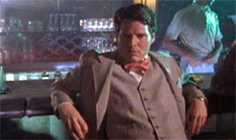 |
It’s news to nobody that serial killer movies have proliferated in pop culture since the start of the 1990s – in mainstream cinema, on True Crime TV, and especially in the various zones of the contemporary B movie, which includes direct-to-DVD fare and telemovies. It is an intriguing fact that this genre, in its B movie form, has created its own shadowy league of mostly overlooked auteurs. Some of the most interesting are indeed what we could call fallen angel auteurs – people whose careers have slid from some fledgling point in the arthouse scene into the sensationalist horror-thriller genres. Ulli Lommel (1944-2017) is a striking case – from Fassbinder and the New German Cinema in the late 1960s/early ‘70s to furious productivity in his punkish, busy riffs on the Black Dahlia, Son of Sam, Zodiac, Green River Killer, BTK Killer, D.C. Sniper … Still more maudit in this respect is Matthew Bright, whose Freeway (1996), starring Reese Witherspoon, broke into the arthouse cinemas of the mid ‘90s. He has directed several films since, but certainly none of them have ever played at any arthouse near me. Freeway II: Confessions of a Trick Baby (1999), featuring Vincent Gallo as a crazed religious cult leader, is a faux sequel with some mighty arresting, sensational stuff about eating disorders and sundry other modern neuroses. Tiptoes (2003) almost re-approached the mainstream with its relatively star-level cast of Matthew McConaughey, Kate Beckinsale, Gary Oldman and Patricia Arquette, but its very intriguing subject-matter – about the only normal-sized guy in a family of little people – doomed it to be a romantic comedy considered as unromantic and unfunny as Martin Brest’s similarly decentred Gigli (2003) with Jennifer Lopez and Ben Affleck. In 2025, it was announced that Bright (approaching his mid 70s) would be directing Spring Breakers 2; in 2026, news broke that he had been replaced by Bella Thorne, who will also be starring in it … And, in Bright’s wayward career, there’s also Ted Bundy. Bypassing the auteur for a moment and going over to the genre, it is worth saying that almost all B grade serial killer movies, at least since The Honeymoon Killers (1970) and indeed earlier (Irving Lerner’s Murder by Contract [1958], for example), are weirdly ambiguous, sometimes chaotic and unformed. It’s almost impossible, in most cases, to figure out their dramatic or thematic logic: i.e., quite specifically, the logic of what they leave out and what they put in, the logic of which point of view they choose to adopt or criticise. I found Ted Bundy, by chance, in a triple DVD pack I bought for a different film, Joel Bender’s Karla (2006), about the Paul Bernardo-Karla Homolka case; that film, too, is worthy of your attention. Bernardo and Homolka are your typical psychotic couple; their abuse and murder of teenage victims involves the extra-frosty alienation-factor of video recording. Bender (1948-2021), whose directorial career goes back to 1979 and Gas Pump Girls, sort-of centres the film on a moral question or intrigue common to psycho-couple tales: was Karla evil, did she kill, or was she manipulated, brutalised by her husband? But Karla is no Badlands (1973): the film fumbles its central mystery by staying doggedly inside Karla’s point-of-view, her account as told to a prison therapist (played by Patrick Bauchau, another art-film escapee) – and then vaguely tries to suggest, at the end, that maybe we didn’t see all, or hear all, or understand all. Mainly, like almost every serial killer B film, Karla stays within a code of sensational, serial literalism: one killing after another, bang-bang-bang. It is this chilling form of literalism, a lack of artfulness – an oddly quasi-avant-garde strategy in this context – that gives these serial killer films en masse their fascinating, chilling effect. Their very lack of commentary, and of affect, seems always perched on the edge of offering, or being, its own kind of commentary on contemporary society: as Raymond Durgnat wrote in 1967, dissing Jean-Luc Godard, his films “say nothing that hasn’t been said better by … ‘commercial’ films like The Mistress, The Doll, or The World Ten Times Over” (1) – the latter, in particular, a 1963 Sylvia Sims movie (aka Pussycat Alley) directed by Wolf Rilla which is also Donald Sutherland’s screen debut (and now finally viewable once more thanks to DVD), pegged by Durgnat as a “study of prostitution, nihilism and non-communication” decidedly superior to JLG’s Vivre sa vie (1961)! (2) William Routt, another voice in this chorus of B film enlightenment, once wrote of literalism and paracinema (long before Jeffrey Sconce parlayed that term into an academic fad). Among gangster films, Inside the Mafia (Edward L. Cahn, 1959) is an example of what edges nearest to the literal. Nothing in Inside the Mafia (until the last sequence) remains unexplained – no volitions, no competencies demand to be inferred, for they are spelled out explicitly, leaving the imagination nowhere to roam. Characters move stolidly without discernible intent through a series of mundane acts, about which the film says absolutely nothing except that they have occurred. Beside this, the films of Andy Warhol seem to seethe with undercurrents and connotations, not to say absurd pretences and refinements. This is paracinema, a film from beyond cinema: raw film which pleases no one, which everyone calls ‘bad’ or ‘boring’, but which, despite that, is one of the few places where our orphan of the nineteenth century actually encounters the period in which it has grown up, one of the few places where the cinema appears an art of today rather than of yesterday. (3) For a long time, in fact most of its 99-minute running time, Ted Bundy is pretty much like Karla in its glassy-eyed, affectless, literalist serialism – Bundy (Michael Reilly Burke) keeps trying to hold his normal life together on the edge of psychotic madness, and keeps killing people, usually with one swift, ugly blow to their heads. The film never spells out, or pushes into explicit coherence, a possible critique of normality as psychotic, something that has filled thrillers since the Stepfather series (1987-1992, with a 2009 remake). After all the killing and the crack-ups, Bright skips quickly over the trial – via some disconcertingly unsutured newsreel footage of the real people – and takes us, finally, to a special moment, a special scene, when finally the film assumes a particularly brutal, frank, stark logic. It is the scene – which seems to go on forever – of Bundy being prepared for imminent lethal electrocution, in which everything he has ever done to others – brutalise them, infantalise them, anally rape them, deprive them of various body parts – is, in a certain symbolic way, done right back to him, tit for tat. First, all his hair is shaved off, revealing an abjectly white dome-pate. All the time he is snivelling, crying, screaming, trying ineffectually to shrink away, to escape within his own completely ‘subjectified’ bodily frame. And he keeps shooting nervous glances (optical distraction becomes an aesthetic overlay-effect here: random light-flares over abrupt shot-ends) at the young guy (cousin to one of the older cops in charge) who is putting on white gloves and arranging many cotton balls. It is the kind of scene in which everyone, indiscriminately, is grotesque: gum-chewing, eye-rolling, talking in hard-boiled phrases that die in the air the moment they are spoken (“Just keep your mind on Jesus” – “You look beautiful” – “Drop them pants”). So then Bundy is held in position so that the young man can “stuff his butt” with several items. So far, all this torture has taken around four minutes of screen time. After that, Bundy is fitted out with a giant nappy, and is led instantly to his execution. Step by step, Bundy’s body-identity is humiliated, cut-down, nullified. Even his death has a deliberate flatness about it: no final spasm of evil afterlife as in Wes Craven’s Shocker (1989) or many gruesome execution movies, no cacophony of machinery or melting flesh – just a disquieting buzz, further optical-distraction flare shots (of the assembled spectators, and of the strange Angel of Death who stands, hooded, at the electrical switch), a nose bleed, and a truncated final speech: “Tell my family I love them. Tell them …” Ted Bundy is a film that likes to leave things unfinished, hanging around like an embarrassment. And it keeps piling on its own endings: the woman who knew him, the naughty little kids who revere him, newsreel footage, a famous photo, a final on-screen bit of narrative info …
NOTES 2. Ibid. back 3. William D. Routt, “Todorov Among the Gangsters”, Art & Text, no. 34 (1989), pp. 113-114. back © Adrian Martin February 2010 (+ updates) |


