 |
 |
 |
 |


|
|
|

|
Together
|
 |
|
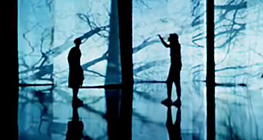
Togetherness? Together (2018) is not the greatest film project of Terrence Malick – but it may be, mercifully, his least known. (Even some detailed accounts of the director’s career seem blissfully unaware of its existence.) Invited by Facebook (via its “creative studio” component, The Factory) to collaborate with Jon Boogz and Charles “Lil Buck” Riley (co-founders of the dance organisation Movement Art Is) and UK visual effects company Framestore on a “360 degree VR experience”, the director undoubtedly seized it as an opportunity to explore and experiment with technological possibilities – as he had previously done on the shorter, IMAX version of Voyage of Time (2016). The
result is, on the one hand, a rather conventional, sentimental, even
trite or corny dance piece, playing on the yawning interval between,
and eventual union of, two male bodies (Boogz & Buck) moving in a
broad set as they enact the difficulties of, and the yearning for, “togetherness”.
The dancers mime bashing on imaginary, invisible walls dividing them (the original choreography was titled “No Borders”), and occasionally make gestures that indicate the 360 degree space around them – looking up into the air or, in the film’s best and most surprising moment, hurling themselves almost directly into the camera lens, as if to break through the circumscribed perimeter. On
the other hand, there is a fairly odd attempt to integrate Malick’s
now familiar brand of “visionary
cinema” into
the realm of virtual reality production. So we have a large, dark,
abstract space in which the dancers move – one
mainly keeps to the left, the other to the right. In long, fluid
takes, the cinematography by Rodrigo Prieto (Martin Scorsese’s
collaborator since 2013) slowly tracks in and cranes up and down to
enhance the depth effects in the image.
Behind the dancers are three circles of multiple, lightly billowing curtains – the rigging mechanism that holds and moves them is visible at the top of the picture, as is the studio lighting – and each of these curtains acts as a screen that contains identifiably Malickian imagery in motion: falling water, clouds, birds in flight, children staring out windows, and so on. Since
the curtains are partly transparent, a layering, superimposition
effect is also created: as we view the same image repeated across
different screens simultaneously, at different angles and varying
differences from the camera, we also glimpse, in passing, multiple
hands, bird wings, tree branches, sea waves, leaves of grass in the
wind, and so on. This projected ‘film’ within the piece – which
I assume is Malick’s
major contribution to the collaboration – follows
a conventional, developmental arc that is also familiar from the
director’s œuvre:
from peaceful images of nature to darker and more chaotic views of
urban life and possibly even war, finally resolving itself in serene
close-ups of an old man’s
wrinkled face.
The final image, replacing that of the set, is of stars in the night sky. No wonder the reviewer for Indiewire judged it as akin to the work of a “first-year film student”! (1) Yet – and this is among the aesthetic disappointments of the piece – there is no real interplay between the dancers and these screens that form, in an inviolable way, their mere backdrop: they never run between them or right behind them; they don’t interact with the visual contents on the screens in any way. The overall effect, strangely for a piece so invested in the newness of its visual technology, is very theatrical – in the worst, most inert sense. The ‘cinema’ component – nice-looking,
luminous shots – is
just something that is concentrated on a bunch of screens,
indifferent and almost incidental to the central, foregrounded
choreography. The general lack of imagination – indeed,
of polyphony of any audiovisual kind – extends
to the soundtrack: simply a piece of orchestral music (uncredited),
with no other sound design component integrated.
There were, for a while, several viewable versions of Together on YouTube, each one constituting a slightly different reworking or rearrangement of the basic material (and, for some possibly technical reason, the basic left/right positions of the dancers are flipped from one version to the other). The first (4.08 mins) is a conventional 2D re-edit of the piece that creates an analytic découpage of sixteen shots, passing from one dancer alone in the frame to the other, and then on to wider shots that show both dancers together. In all shots, there is a warped-space effect created (whether in the camera lens or at the post-production phase), doubtless to let us at least intuit the 360 degree totality of the original experiment. The other version (5.37 mins), no longer viewable online, is a mock-up that allows a scan of the continuous, 360 degree image: left and right, up and down, all around. But there is not much to discover by playing with the optional viewer-controls: the ceiling and floor don’t display any action, and large parts of the set are simply left unoccupied for most of the available time. It could be said – and surely its makers would say – that there is a democratic option for the viewer created here, since one can choose to look at one dancer or the other when they are far apart, or select how to exactly pass our gaze from one to the other at these moments. But this is, finally, a very limited kind of freedom; it’s assumed, from the outset, that it’s the ‘real presence’ of human movement and behaviour we’ll want to be looking at, not the generic kitsch that’s fluttering away on the background screens. Like the common assertion that (as Kit Messham-Muir said of Shaun Gladwell’s 360 degree VR piece Orbital Vanitas, 2017) “VR has no frame”, (2) the quasi-Bazinian claim of an infinite or limitless view allowed by this new technology is a fine myth: of course, there are edges to the image (they have simply been “wrapped around” and joined in order to create the illusion of a seamless expanse), and there is rarely any strong or lingering ambiguity for the spectator concerning where to look at any given moment. Even shortly after the initial release of Jacques Tati’s Playtime in late 1967 – a film that, for some, prophesied a new, immersive, democratic viewing experience, with its multiple, simultaneous gags and plot threads rendered in long shots on a vast screen – the Cahiers du cinéma critic Jean-André Fieschi tempered his enthusiasm enough to wisely note the following. It would doubtless be somewhat hasty to claim that the spectator is free to wander along his or her own path, or to invent their own découpage: a second viewing confirms, on the contrary, the imposed routes, whatever our wishes for independence, and this by way of an incredibly authoritarian control of all the scattered signs (such as with, as Tati avows, the use of colour). (3) What is most striking about the second, interactive version of Together – especially in comparison with its flatter rearrangement – is its recourse to editing. It has eight created shots, half as many as the other version. Most of the cuts occur when the lighting is dimmed, and our principal attention is placed, briefly, on a flurry of images playing across the curtains – thus, when the set loses its strict, visible contours. There is, however, one absolutely classical match-cut on action, a raccord when one of the dancers performs a striking gesture that extends upwards. In other words, all these cuts are striving not to be seen – to be invisible, a pure expression of the total spatial experience and its carefully choreographed fluidity. The only real cutting that happens is internal to the curtain-screens – precisely where it doesn’t really matter, or count for much. In this way, Together inadvertently reveals something that is radically other to its own intended nature. The idea of a fast-cut 360 degree VR experience, where the editing is meant to be seen and felt, is literally unthinkable in our contemporary cultural climate. We can hear the anguished cries of the technicians already: that would be just too much information on the visual and sensory planes for any viewer to handle! So, perhaps the ghost of André Bazin has triumphed here, after all: editing is, once again, prohibited. (4) But why should this be so? There is no requirement to make territorial, totalised enemies of cinema and VR, but we do need to be clear about some of the essential differences at play between these media forms (and across their histories) at present. One often reads or hears, these days, anguished odes to “the frame” – as in US filmmaker Jeff Kreines’ fairly typical cry on social media that “VR is for ‘filmmakers’ who wouldn’t know a decent frame if it bit them in the ass.” But it would be wrong to conclude that this is, first and foremost, a matter of good or canny framing in the sense of pictorial composition. The question of the presence or absence of a frame is important in cinema mainly because of what it implies and leads to, especially in its intimate interrelationship with editing. First, the ever-present possibility of shifting between multiple perspectives (not only those of fictional characters, but also of the narrating camera itself); and second, the always virtual, frequently dynamic implication of off-screen space, in the diegetic sense (as Stephen Heath, after Noël Burch, initially defines it) of “the space beyond the limits of the frame, there in its absence and given back, as it were, in the editing of shot with shot or in camera movement with its reframings” (5) – while also bearing in mind the larger possibilities (raised variously by Pascal Bonitzer, Catherine Fowler and Gilles Deleuze) of other, simultaneously operative types of off space, whether imaginary, historical, virtual, or part of the heterogeneous materiality of the filmmaking process itself. The off is a zone of invisibility constantly shadowing and complicating what is made visible. And as Serge Daney rightly remarked to Bill Krohn in 1977, this off-screen is just as much a matter of sound as of image: “Each shot secretes its off-space. There are different off-spaces and different ways of playing on them. There are off-spaces directed by the eye (fetishistic framing) and off-spaces directed by the ear (fundamental voice, voice of the mother)”. (6) In Together, as just one example of the burgeoning VR field, there is no tension of an off-space, whether cued visually or aurally – and thus no real possibility of an editing cut that could displace or and move us elsewhere in a definite sense. Partly, this is because physical camera movement has been effectively replaced by the very particular (and less determined) gaze-movement of the VR spectator. On the other hand, since this spectator cannot see all the way around (the full 360 degrees) at any given moment, there is still the possibility of “missing” something – something that could be cued, for example, through sound. But montage effects, on any synchronic and metonymic level (i.e., from shot to shot), would appear to be off the table in this context. By contrast, 360 degree VR, as it stands, represents a wilful reduction of these fundamental possibilities of cinematic language. It often does so while flaunting the alibi of freedom: the increased freedom of spectators to choose their own path, shape their own experience. This particular aspect of techno-discourse has taken many guises since the 1990s. Paul Brown, for instance, described collaborative, networked art as detonating “the idea of art as extrinsic signifier”, i.e., a single-authored artwork that comes in its “gilded frame”. (7) Centuries of Romantic art had elaborated, according to Brown, a quasi-fascistic tendency to dominate their spectators – that “authoritarian control” of which Fieschi spoke in relation to Tati. It is intriguing to see, at present, the backlash to several decades of this discourse, a counter-reaction represented by Lars Henrik Gass’ polemic Film and Art After Cinema. Going further than Raymond Bellour’s argument that the cinema experience as traditionally defined offers a precious dispositif of bounded time, space, narration and attention, (8) Gass even celebrates that supposedly fascistic-authoritarian trait of cinema’s apparatus: the wonder of cinema, for him, is that it imposed on us a view or gaze that was not our own, and not a simple reflection or record of the world outside the theatre, either. In a phrase that recurs often in his book, we are “compelled to perceive” cinema – whereas digital video loops and art installations are things we can happily regard distractedly, indifferently. Cinema once stood (this history is conjugated wholly in the past tense by Gass) for pure alterity, something radically different from and challenging of the world, and of our own, socially formed sensibilities. (9) The often desperate ideology of interactivity at all costs has now largely shifted from forking-path experiments in web-narrativity – experiments which may have reached their official dead end in the Black Mirror “Bandersnatch” special of December 2018 – into the avenue of VR immersion, with its vaunted freedom to glance in any direction, wander about in the space, and so on. But there are severe aesthetic limits on the raw material that is being offered up to our spectatorial liberty in the 360 degree VR experience. In a Facebook post of February 2019, the Australian artist Carl Looper (who has been closely involved in the technological design and development of various VR projects) commented on these limits. In VR there is nothing that corresponds to cinema’s point-of-view shot. This is not because VR is incapable of a point-of-view, but because it is entirely incapable of anything but a point-of-view. If the cinema can give us a point-of-view shot, it is because it has learned how to do otherwise. (10) The almost unquestioned assumption within the VR industry that this technology allows, first and last, a subjective experience for the viewer (via the evocation of a single, unbounded POV “shot”) simply plays along with larger trends in mainstream audiovisual culture (for instance, in blockbuster “event” movies) that bypass the constitutively multi-perspectival nature of cinematic storytelling (the type of complexity that Bellour values) for the sake of character-centred immediacy and identification. Looper adds a further comment. There is no reason why, in VR, one can’t jump from one POV to another. Just as in the cinema, there is no reason why one can’t jump from a wide shot to a close-up. Or from one angle to another. By playing with such, one can then extend it to create a sense of a world in which you (as the audience) are much more than just occupying a particular point of view (or multiple POVs) on the world (or in the world). But how to do that in VR? (11) Together: think on this title. It conjures the dream of totality, wholeness and fusion that drives so much current work in VR, and so much discourse in and around it. We can look from one dancer to another in Malick’s piece, but eventually we will follow them as they become “as one” – and, moreover, within a scenic space (however abstracted) that is itself whole and indivisible. The degree to which any headset-wearing (or 360 degree view-jiggling) spectator can truly be immersed in such a spectacle is, again, largely a matter of incessant, industry-led hype, in a cultural context where the catch-word of immersion goes hand-in-hand with the sovereign claims of subjectivity and immediacy. (12) In his review of Aboriginal artist Christian Thompson’s Baya Gardiya (2019) as exhibited at the Australian Centre for the Moving Image (ACMI) in Melbourne, Philip Brophy gives a salutary, disenchanted view of the VR experience. Produced by the Sydney self-described “innovation, venture and postproduction driven company” Nakatomi, the visuals are formed as a stereoscopic linear experience: one is placed within a spherical dome, so that one can stand still and tilt one’s head around to perceive an inverted, in-the-round set design that reconstructs the actual terrain of Thompson’s homeland as concentric rows of slightly bowed and curved cut-out images of trees, rocks, sand, and sky. As with the affective logic of VR, you aren’t ever “immersed” (unless you possess the limited scopic acuity of a five-year-old), but instead, you are placed in an ornate pseudo-phantasmagorical encompassing panorama. It’s mostly like inhabiting a slightly expanded pop-up book, where turning each page opens up the predesigned staging and faux-naif layering of foreground and background façades and props. (13) But it is not, first and foremost, the artist whom Brophy accuses in this account. Probably all VR pieces that exist and have been exhibited to date – certainly the more elaborate and expensive ones – are complicated, collaborative negotiations between artists, technical teams, commissioning curators and other players with a stake in the result (as was the case with Together). What are the implications of that? Could we not for once be clear about this: Australia's “moving-image culture” is governed by the advertising industry. Every agency, every collective, every production facility, every postproduction house, every design consortium, every management company […] Every time you connect an artist to this realm, all it does is make the commissioning institution seem professionally aligned with an industry, and the lazy art community – curators and audiences alike – think that slick cinematography and off-the-shelf VFX make video art so much better. (14) For his part, Gass adds many droll details to this line of critique; he paints the withering portrait of a contemporary artworld obsessed, when it comes to any kind of media art (Christian Marclay’s The Clock [2010] figures among his key examples), with the type of value that is purely external to the work, and loudly advertised as being so: the time taken to make it, the vast resources marshalled, the diverse technical teams involved in its flawless execution … and, above all, in the tally of money spent, and the number of spectators drawn to visit it. (15) Certainly, whenever smoothness, seamlessness and slickness take over the VR realm, we are in the presence of advertising aesthetics – and this is a bind that, materially, seems impossible for most artists (filmmakers or any other type of artist) to escape at the outset. Alternatives to this sorry situation, anywhere in the world right now, are not easy to find. Elena Gorfinkel has rightly celebrated an exception: Tsai Ming-liang’s The Deserted (2017). In certain of its parameters, this case is no different from others already mentioned; it cost 1.5 million dollars, and Tsai entered into a collaboration with a team of technical experts from HTC and Jaunt China who, for instance, ruled out one particular stylistic parameter from the outset: no close-ups. (It is a telling reflection of this founding interdiction of the VR realm that, likewise, Malick’s only close-ups in Together are presented in minimised form on the curtain-screens.) Yet, as Gorfinkel stresses, Tsai’s presentation of this work in his London masterclass did not brandish a typical “VR has no frame” rhetoric, but rather insisted on the continuing presence – even in the virtual realm – of the frame as master-concept and a “mysterious invention: is the frame a limitation, or an encouragement to extend into the beyond?”. (16) Gorfinkel
details the ways in which, true to his other work in film and digital
video, Tsai uses the 360 degree VR format to continue an exploration
of environment (much physical, non-human detail can be studied in the
location), duration (the piece is 56 minutes), and daily routines or
rituals. As we might expect, Tsai does not banish his usual practice
of complex, ambient sound design for the sake of an overriding piece
of music, as Malick did in Together;
all the same, like Fieschi, Gorfinkel underlines the way in which
Tsai’s “staging
compels the gaze to remain on performers’ bodies”,
thus directing our attention and delimiting any supposedly “pure” or
unbridled freedom of the spectator.
When
compared to Together,
something else can also be underlined: where so much VR work is
fanatically dedicated to tales, notions and states of unity and
fusion (i.e., togetherness), the type of floating or suspended
narrativity honed by Tsai over three decades opens a radically
different field of possibilities.
Ghosts come and go in the space, encounters between bodies may be only tentative (or may turn dramatic, as in The Deserted’s sex action), and passing time can be filled by repetitive, mundane gestures, as in much minimalist or (supposed) slow cinema. There need be no conventional, developmental or sentimental arc of plot and incident – the type of arc invariably imposed by the advertising industry’s reigning aesthetic and storytelling sense. In
the light of Looper’s
comment that “the
issue for me is [the] default ‘in
body’ conception
of the universe. It is the primary feature of VR. The reason it
exists. But it is also a prison”,
(17) we can see that, while Tsai (as he has commented) invites the
spectator into the virtual space as a type of temporary “home”,
he also finds a way to empty out that default, in-body subjectivity
of viewers, turning them into another species of ghost.
I conclude this essay by taking a leap away from the hyper-technological sphere of VR exhibitions. For several years before his death in May 2019, French filmmaker Jean-Claude Brisseau experimented with 3D processes. Like Jean-Luc Godard in The Three Disasters (an episode of 3x3D, 2013) and Goodbye to Language (2014), the context was low-budget, and the results were (to put it mildly) eccentric – even subversive. In his final feature (mainly filmed in his own apartment), Que le diable nous emporte (Tempting Devils, 2018), Brisseau created other-worldly 3D sequences in which his characters went on cosmic transports (thanks to transcendental meditation). These strange sequences are notable, most of all, for the freedom with which Brisseau deploys a particular type of editing shot-change: while the foreground bodies stay in the same position, the background flicks wildly from one vista to another. There are none of the smooth transitions – like dimmed lighting or post-production dissolves – deployed to mask the montage on the curtain-screens in Together. Brisseau simply assumes such rampant discontinuity as one of the constitutive cinematic tools at his disposal. His off-spaces are declared as such: violent, riddled with holes, leaping from one plateau to the next. The unselfconscious surrealism of Brisseau’s aesthetic method here (and elsewhere in his career) recalled for me the words of Claude Ollier on the special effects processes of the original King Kong (1933), when he posited their commonality with the “world of dreams”, a world that he described in strictly cinematic terms: “spatial effects, optical dislocations, sequential breaks and general discontinuity”. Ollier went on to evoke a specific aesthetic experience. … a visual universe which perfectly realises the ‘collage’ effect basic to any nightmare vision: stippled space and stippled time, gaps, fringes, overlaps and incompatibilities in action, zones of imponderable duration, void, into which apprehensions of unreality tumble headlong. (18) Stippled space and time, incompatibilities in action, zones of imponderable duration: could this be a way forward for experiments in 360 degree VR work? I am reminded of the way that, for example, Raúl Ruiz treated the process of “documenting” the performances of Jean-Claude Gallotta’s dance troupe in Mammame (1986). Going in the opposite direction to Wim Wenders’ “holistic” 3D rendering of the performances by the Tanztheater Wuppertal in Pina (2011), and inspired by Gallotta’s micro-movement techniques that dissolved all psychological characterisation and plot-reading of the dancers’ gestures, Ruiz broadened and multiplied the intervals between shots, rupturing time, space and POV, and created a remarkable soundscape mixing disarticulated vocal sounds and music. Ruiz never got a chance, before his death in 2011, to work with 360 VR technology, but years earlier he had already sketched out the speculative possibilities of a CD-ROM format that would allow a given scene to be viewed (and re-viewed) from diverse perspectives and points-of-view, undergoing wildly different mise en scène treatments … (19) Like Tsai, Ruiz was not hooked on the ideology of seamless audiovisual continuity, or what I’m here calling togetherness. He wanted to devise interactive systems that would slyly invert and disrupt their own initial premises as they played through – as many of his shorts and features did in a pre-set but highly hallucinatory manner. We can only wonder what fanciful games Ruiz would have contrived to upset the in-body subjectivity of the VR format; but the challenges his œuvre leaves behind are clear. As Looper muses, VR needs to “get past the wide shot” (20) as its default aesthetic option – and start investigating the cracks of untogetherness. MORE Malick: The New World, The Tree of Life, A Hidden Life, Badlands, Days of Heaven 2. Kit Messham-Muir, “Taking a VR Trip in Shaun Gladwell’s Floating Planetoid Skull”, The Conversation, 17 January 2017. back 3. Jean-André Fieschi, “Le carrefour Tati”, Cahiers du cinéma, no. 199 (March 1968), p. 26 (my translation). back 4. See “Editing Prohibited” in André Bazin, What is Cinema? (Caboose, 2009), pp. 73-86. back 5. Stephen Heath, Questions of Cinema (Macmillan, 1981), p. 33. back 6. Bill Krohn, Letters from Hollywood 1977-2017 (SUNY, 2020), p. 22. back 7. Paul Brown, “An Emergent Paradigm” (1996), reprinted at: https://dam.org/museum/essays_ui/essays/an-emergent-paradigm/. back 8. See Raymond Bellour, La Querelle des dispositifs. Cinema – installations, expositions (P.O.L, 2012). back 9. Lars Henrik Gass, Film and Art After Cinema (Multimedijalni institute, 2019). back 10. Carl Looper, Facebook, 21 February 2019. back 11. Ibid. back 12. 2026 postscript: This theme is taken up vigorously and illustrated across many sorts of cultural manifestations in Anna Kornbluh, Immediacy, or The Style of Too Late Capitalism (Verso, 2024). back 13. Philip Brophy, “Christian Thompson’s Baya Gardiya” (2019), reprinted in his Screenic: Politicised Writings on Being Screened (Discipline, 2024), p. 248. back 14. Ibid., p. 250. back 15. Gass, Film and Art After Cinema, pp. 115-142. back 16. Elena Gorfinkel, “‘To Extend into the Beyond’: On Tsai Ming-liang’s Late Digital Style”, Sight and Sound online, 22 April 2019. back 17. Looper, Facebook. back 18. Claude Ollier (1965), “A King in New York: King Kong”, in Jim Hillier (ed.), Cahiers du Cinéma 1960-1968: New Wave, New Cinema, Reevaluating Hollywood (Harvard University Press, 1986), p. 193. back 19. Ruiz discussed this at the International Rotterdam Film Festival, January 2004. back 20. Looper, Facebook. back
|


