 |
 |
 |
 |


|
|
|

|
Vladimir
|
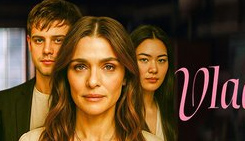 |
Something odd and almost imperceptible happens within the first few shots of Vladimir. The narrator, writer-teacher ‘M’, introduces herself to us in her getaway cabin, directly speaking to camera, in a break from scribbling on her pad. First view: Rachel Weisz (in life, age 56) as M tells us she “may never again have power over another human being” – because of general loss of attractiveness, and specific loss of charisma in the eyes of her young literature students (who nonetheless let her know, repeatedly, that they think she’s “hot” only minutes later in this opening episode). As
she says this, we might notice typical film/TV tricks of
de-glamourisation: somewhat harsh lighting that makes the actor’s
skin flat, puffy, even a bit blotchy; casual nothing-clothing. Yet,
over the course of the next two shots in supposedly continuous time
(as she goes to her bookshelf, and then nonchalantly approaches a
mysterious, younger chap tied up and drugged unconscious in a chair),
Weisz begins to look … well, just as she usually looks on screen.
She starts to glow; the marks of not-beauty swiftly fade. It is a
strange procedure for a lifestyle comedy, to more-or-less deny or
detonate its premise within mere seconds.
Maybe – especially in light of the reality/fantasy/mildly-metafictional convolutions of the final episode, which loop back to this cabin scene – there’s some kind of internal justification for the evasive sleight-of-hand: M steps into her own dream and actualises or renews herself – something like that. But I am not convinced. Vladimir, adapted – or rather, very stretched out – from a popular 2022 novel by Julia May Jonas (who also provides some of the TV scripting) – plays with various Zeitgeist-y topics. Its closest cousin is Luca Guadagnino’s underrated After the Hunt (2025): older professors, from “a different time” of libertarian sexuality, clash with contemporary, politically hypersensitive students who call foul on various forms of harassment and abuse. There’s intrigue, ongoing legal proceedings, a dash of frisson, careers on the line, reversals, revelations … much of which is carried through the plot-thread of M’s husband, John (John Slattery from Mad Men), hauled into court for sleeping with several students (a decade or more ago), and being officially defended by his own (lesbian) daughter, Sid (Ellen Robertson). Vladimir is, however, mainly played for low-level laughs. And no more so than when we meet Vladimir (Leo Woodall) himself: a younger, supposedly even hotter prof/novelist (it’s all creative writing rather than After the Hunt’s theory scholarship, which is harder to sell to the mainstream consumer) whom M desires – cue endless imaginary-flashes of clothes-ripping, falling onto available surfaces or against the nearest wall, etc. Every narrative line is drawn out in a plodding way across the eight episodes, and there is a great deal of repetition to add further padding – I have not yet added the ‘backstory trauma’ element of Vlad’s pill-addicted wife, Cynthia (Jessica Henwick), and her fateful encounter with John. The central feature of the series is Weisz’s to-camera complicity. There’s a shot change to signal her turning and confiding in us; or even within a held shot she’ll break out of the scene just a smidgin to wink, glare, whatever, at us. But this creates a (shall we say) ambient problem both for Weisz as a performer and for the general mise en scène: even when M is not addressing us, her exaggerated bodily and facial reactions to every darn thing that is done or said are projected beyond the frame to us, since only we (it seems) can ever ‘read’ her correctly. Everybody else in frame – starting with the prize doofus, Vladimir – picks up nothing of this ever-present actorly-mugging in situ. I like Weisz, but this is just too, too much. TV series in the mid 2020s have become obsessed with what I interpret as ‘director casting’ – even as the showrunner remains, as ever, ruler of the roost in every major respect, setting and enforcing the style-and-manner template of the whole piece. The cultural identity-profile of the appointed director must (be seen to) fit the intent of the series, even of the specific episode! So here, it’s almost an all-female directorial ledger (to match the all-female writing team) for the sake of prioritising ‘the woman’s point-of-view’ – apart from Robert Pulcini who’s half of a pair with Shari Springer Berman (I appreciated their American Splendor back in 2003, but haven’t followed up on their subsequent output). Just checking the Wikipedia bios of these hired hands is instructive: Italian-American Francesca Gregorini comes from a family of screen and pop music celebrities, has released a CD, and co-directed her debut (Tanner Hall, 2009, never heard of it) with Princess Tatiana von Fürstenberg; while Josephine Bornebusch from Sweden has a background in comedy and variety TV, and handled two episodes of the memorable Baby Reindeer (2024). For all these reasons, right throughout Vladimir I kept imagining it as the feel-good, comedy-of-manners flip-side to another Rachel Weisz TV vehicle (also mostly directed and entirely written by women, with the overlap of Susan Soon He Stanton): the elaborate ‘re-imagining’ of David Cronenberg’s Dead Ringers (2023). I recommend that in place of Vladimir. © Adrian Martin 23 March 2026 |


