 |
 |
 |
 |


|
|
|

|
Gary's Story
|
 |
|
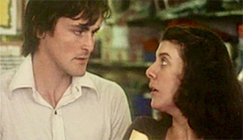
What’s refreshing about Richard Michalak’s Gary’s Story: the emphasis is firmly on the story, rather than on Gary! It does not centre on a leading, individual character, as most Australian narratives do – thereby disguising its activity as film and as language, wanting us to believe in, identify with and understand this imaginary person. Gary is only a pretext for the story. And this story is not his (doesn’t belong to him); it’s wholly taken in charge by the film and its inventive creative process. It’s a story interrupted, shifted, constantly played out anew. More an anecdote than a realist chronicle (which tends to be the default Aussie Storytelling mode). Simply relating the plot would do this film an injustice, implying that it refers to a schema of real time and actual places. But when Gary (John Howard) moves to Sydney to find erotic fulfilment, what we see is not Real Sydney but Travelogue Sydney: an expository montage complete with Tommy Leonetti singing “My City of Sydney” on the soundtrack. Likewise, the temporal logic of the film is based on purely formal narrative jumps and connections, rather than a standard, illusory sense of real time passing. Sally (Katrina Foster) warns Gary that, if he dates her, he will be bored; cut to the two of them on a park bench, with him yawning. Later, Sally’s extended unwanted stay in Gary’s bachelor pad is superbly conveyed in a series of shots of Gary waking up with a violent jolt on the couch, as she turns on the blender each morning. It would seem that the principal influence on Gary’s Story (scripted by Marc Rosenberg) is Woody Allen’s Annie Hall (1977). But Michalak takes even bigger risks than its progenitor by making the characters immediately less lovable. Behaviourally, they are nasty, boring, exploitative; and narratively they are puppets, functions, stereotypes. The ‘other woman’ in the story’s triangle is played with perfect, complementary symmetry as the knowing, sensual femme fatale (“I don’t mind you staring as long as it leads to something”), and Kate Fitzpatrick, no less, is on hand to incarnate her – an intriguing ‘star system’ mentality (in the Australian context, at least) that enhances the intelligent wit of the project. The film is daring, too, as a comedy that occasionally threatens to become something else entirely – Sally’s suicide attempt, for example, is played almost as straight drama. Having made this leap, however, Michalak compounds the generic transgression by immediately dissolving that drama and returning to a play with narrative form. When Gary rewrites the ending of ‘his’ story and resurrects Sally – this time with a new boyfriend who is a policeman – he wonders: “I’m not sure the first ending wasn’t better”. Such, generally, is Michalak’s method: tentatively establishing a coherent flow, then breaking it by shifting to another register of film language, a different set of conventions. Dialogue becomes into-camera monologue; the lighting alters and Sally quotes (with the appropriate American accent) Gone with the Wind (1939); pieces of the plot are lost in ellipses or shoved into off-screen space where they can only be heard. And all in 24 minutes! There’s no need to overrate Gary’s Story. It’s a good, smart film – with an excellent grasp of the short form. But, in comparison with the majority of film school productions in Australia – which rarely get past a zero degree level of dreary plot-and-character mainstays – it acquires a positively progressive aura. It pretends to be nothing other than what it is: a game, trying on a multiplicity of modes and styles. In
this light, it puts me in mind of the accolade that Serge Daney bestowed on Annie Hall four years ago in the pages of Cahiers
du cinéma (no. 282): “Here is a filmmaker working on
what, in cinema, is important to us today: that every image implies a
point-of-view, that every point-of-view divides, and that every
division is productive”. 2026 Postscript: This piece was commissioned in early 1981 as part of a series on Australian short films; the others were the comedies Buckeye and Pinto and Terror Lostralis, and the drama Now and Then. I didn’t mention this in my original review, but Gary’s Story was produced within Richard Michalak’s time as a student at the AFTRS (Australian Film, Television & Radio School – or, as it was in ’81, just the AFTS sans Radio) in Sydney. He trained and subsequently worked as a cinematographer. Both he and writer Marc Rosenberg (December Boys, 2007) continued their collaboration, forged at AFTRS, with director Rolf de Heer, who served as producer on Gary’s Story. Another name of note in the credits: editor Ray Argall, later a celebrated director and today ace restorer of Australian films. Plus: the cinematography credit is shared between Joseph Pickering (later to work extensively in TV) and, near the end of his life, Brian Probyn (1920-1982), whose remarkable career bridges Lindsay Anderson, Ken Loach, Michael Ritchie, John Duigan, Tom Cowan, and Terrence Malick’s Badlands (1973). I continued (far more explicitly) my critical investigation of Australia’s film school training programs in my 1984 essay “A Practical Film Student’s Guide to Cliche”, which appears in a 2025 Spanish translation by Iván Bustinduy here. © Adrian Martin March 1981 |


