 |
 |
 |
 |


|
|
|

|
Now and Then
|
 |
|
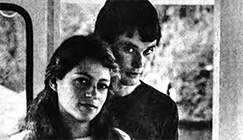
Now and Then is a lousy film; its lousiness is both particular and symptomatic. Rather than simply bash it, I’d like to discuss, rather, those symptoms: the ways in which it represents the failure of a certain kind of cinematic ambition in the area of the short film in Australia. (1) The essential problem is this. The hearts of a great many people working in short films are somewhere else – they want to be making features. And usually very respectable, professional, noble features, the kind of film-mentality that critics support and enshrine when they say stuff like: “We expect our filmmakers to show us to ourselves, to enlighten us about the nature of our own lives, to articulate something of what it means to be living in Australia in the second half of the 20th century”. Thus spoke, for instance, the prominent media educator Jack Clancy [1934-2014]. (2) So, if I have my eyes set toward the future, and I’m stuck here and now with an (on average) 20-minute film assignment, what do I make? A film that is a virtual trailer for the one I really want to make, a Reader’s Digest-type condensation of a story that needs between 80 and 90 minutes to spin itself out effectively. A strangely compressed and claustrophobic film that pathetically pleads: don’t look at me, don’t listen to what I’m saying, just swallow my oh-so sincere, all-Australian theme! It gives me nightmares to imagine legions of aspiring directors, whether independents or film school graduates, wanting feverishly to make film called Now and Then. Why? Because that title says it all: Australia’s history, its young and old generations, life as it is (the everyday) and life as it was … i.e., the entire humanist spin-cycle! Assuming that such a film should be made (without prescribing or standardising it as the above quotation does), one thing is clear: the short film format is just not the place to do it. Now and Then has learned none of the lessons that Richard Michalak’s Gary’s Story (1980) displays. It is cripplingly dependent on a realist logic: we are meant to accept these people, places, times as believable and worthy of an emotional response. But it ends up merely referring to everything, simply noting down (as it were) characters and incidents in a fleeting fashion – for the almighty theme is paramount, and it has to be squashed into the available 50 minutes. Director Mark Turnbull (3) constantly assumes that we are willing to fill in the exposition ourselves (who are these people? what did they do before the story’s start?) and development (the deepening relations between characters) – a very bad, unworkable assumption. Only a specialised form of narrative is possible (or, at least, works best) within the short film format: the anecdote, which depends less on emotional response than on an appreciation of the work’s own logic and cleverness. Richard Wherrett’s The Girl Who Met Simone de Beauvoir in Paris (1980, adapted from a Frank Moorhouse story) is a good conventional example; while Gary’s Story treats the anecdotal mode in a more experimental but still mainstream way. Alas, the critical cards are stacked against the anecdotal film almost as much as they are against truly avant-garde cinema. A clever movie, a cerebral work that knowingly takes aboard stereotypes and citations, is still deemed somehow lacking – lacking in commitment, sincerity, depth, not to mention that burning, nationalistic desire to “show us to ourselves”! Now and Then happens to be a lousy film because of its blinkered perspective on its subject matter/theme. It’s ‘about’ unemployment, and assumes that it is enough to simply show the main character, Garry (Ian Gilmour), (4) sleeping through the morning and then trudging off to the CES (Commonwealth Employment Service) in order to convey the experience and significance of being out of work. Yes, Garry has several chance encounters with people who question his values (played by Tony Barry, Lisa Peers and Joan Winchester). But that’s not enough, when you have a film – like far too many of its kind – that reduces the art of direction to an even, bland, television-style functionalism, tricked up with a few showy camera movements, and fills the soundtrack with supposedly appropriate Muzak-type filler. Is this how style is taught in our national film schools? But even if Now and Then were better on these counts, it would still be a blameless victim of the all-pervasive Impossible Dream that instils in our filmmakers the drive to make a particular kind of commercial, narrative feature wherever they are situated, even if that situation (such as a short film) is entirely inappropriate to it. The
victim of a film culture that sets about
determining and regulating the types of cinema it is deemed possible to practice. A victim that has grown up into the world hearing that solemn voice that every time
begins: We expect our filmmakers … NOTES (2026) 2. Jack Clancy, “Australian Cinema in Perspective”, Buff, no. 1 (17 October 1980), p. 4. Jack subsequently hit back at me in the letters column of Cinema Papers magazine, as only he could, for this passing slight! back 3. Mark Turnbull (1950-2009) amassed many impressive credits in the global film industry as producer, assistant director and second unit director between 1976 and 2008, but directed nothing after Now and Then. back 4.
Gilmour, beyond his occasional acting career, has since become a
prolific director for Australian TV series. An instantly recognisable
figure, his most recent screen appearance was in John Duigan’s Careless
Love (2012). back © Adrian Martin February 1981 (+ Notes July 2026) |


